
Introduction
“AI-powered,” “automated,” “intelligent,” and “agentic” show up almost interchangeably in ERP marketing, which makes it genuinely hard to know what you're actually being sold. These are not the same thing, and the difference affects what you should expect a feature to actually do. This is a plain glossary, not a sales pitch for any one of them.
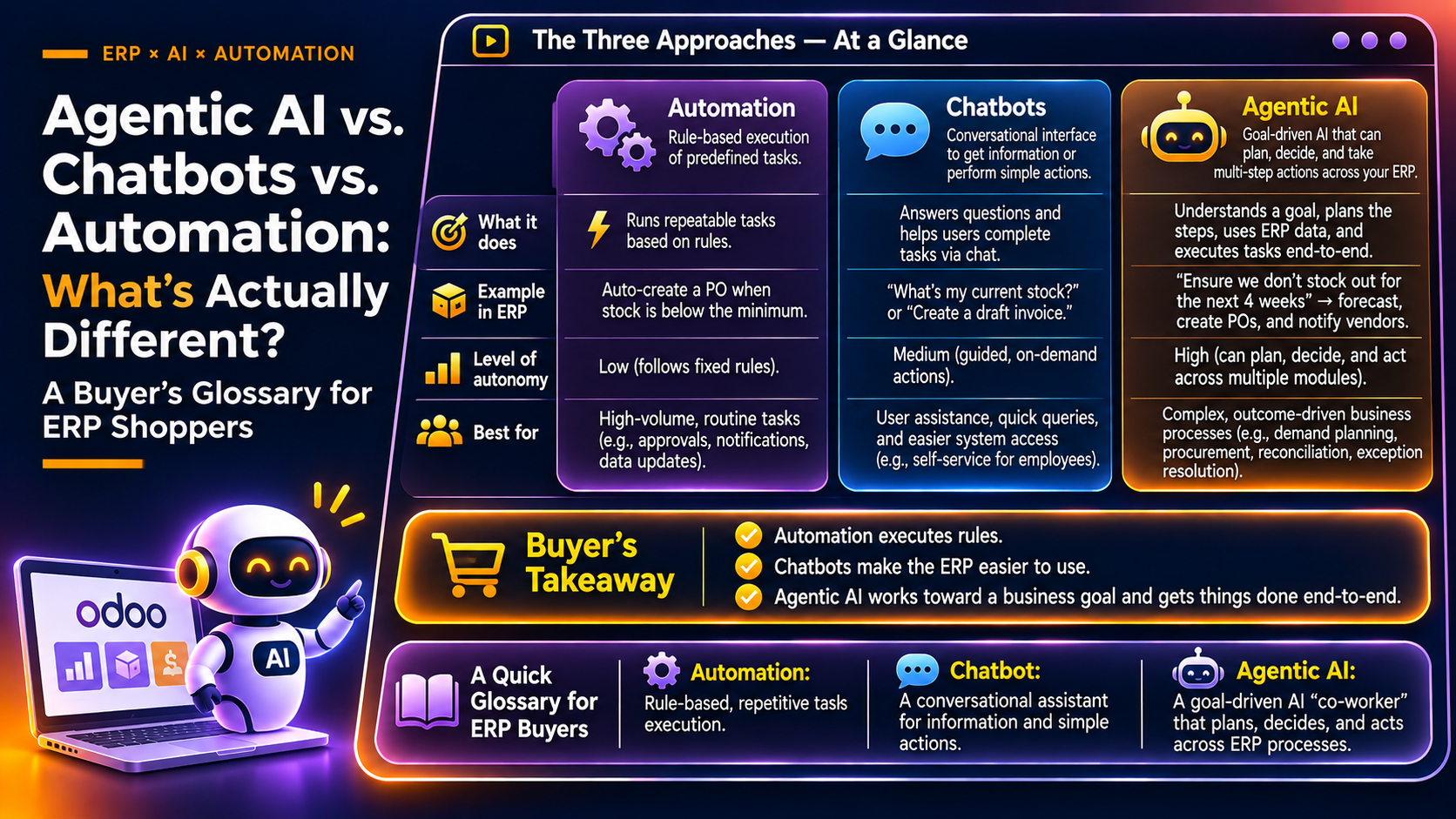
Traditional Automation
Automation follows an explicit, pre-defined rule: if X happens, do Y. “If an order's total exceeds $10,000, require manager approval” is automation. It's deterministic — the same input always produces the same output — and it requires someone to have anticipated and configured the rule in advance. This is the oldest and most reliable category here, and it's still the right tool for anything with a clear, stable rule.
A Chatbot
A chatbot is a conversational interface, typically built to answer questions from a defined set of information — documents, FAQs, order status lookups. It responds to what you ask, in natural language, but it doesn't take independent action or make decisions beyond retrieving and presenting information. A support chatbot answering “what's your return policy” is a chatbot. It is not, by itself, agentic — it's a smarter interface on top of a lookup.
Agentic AI
Agentic AI goes further: it can reason across multiple data sources, make a judgment call within defined boundaries, and take a multi-step action toward a goal — not just answer a question, but complete a task. An agent that reads Sales, Inventory, Manufacturing, and Purchase to identify which orders are at risk of late delivery, explain why, and draft a vendor follow-up is agentic: it's reasoning across connected data and proposing an action, not just retrieving a pre-written answer.
The defining difference from a chatbot isn't that it's “smarter” in a vague sense — it's that it operates across systems and can propose or take multi-step action, within guardrails a human sets and typically still approves.
Feature Comparison
| Characteristic | Automation | Chatbot | Agentic AI |
|---|---|---|---|
| Follows a pre-set rule | Yes, explicitly | Sometimes, for canned answers | No — reasons dynamically |
| Understands natural language | No | Yes | Yes |
| Reads across multiple data sources | No, single trigger/action | Limited, usually one knowledge base | Yes — core capability |
| Takes multi-step action toward a goal | No, single action | No, retrieves/responds only | Yes, within set guardrails |
| Needs the scenario anticipated in advance | Yes, fully | Partially | No — handles novel questions |
Why This Distinction Matters When You're Evaluating a Vendor
A vendor calling a basic approval workflow “AI-powered” isn't lying exactly, but it sets the wrong expectation — you're buying automation, which is fine, but you shouldn't expect it to handle a question it wasn't explicitly configured for. Conversely, a genuinely agentic feature — one that reads across your live data and reasons through a multi-step answer — is a meaningfully different capability, and worth asking a vendor to demonstrate specifically, not just describe.
The practical test when evaluating any “AI” claim in an ERP demo: ask it a question that requires combining information from two different modules it wasn't specifically pre-configured to connect. A chatbot or automation rule will fail or redirect you. Genuinely agentic AI will reason across both and answer.
Ready to Try It?
See the difference for yourself — ask our AI agent a real cross-department question. Book a Free Demo at hirebeans.cloud.
Book a Free Demo