
Introduction
A logistics or delivery-heavy business evaluating Odoo reasonably wants to know, specifically, what's handled natively versus what requires a separate tool. This is worth being precise about, since “does Odoo do delivery routing” doesn't have a simple yes-or-no answer — some of it is genuinely built in, and some of it is a job for a dedicated routing app or service connected to Odoo's data.
What's Actually Built Into Odoo
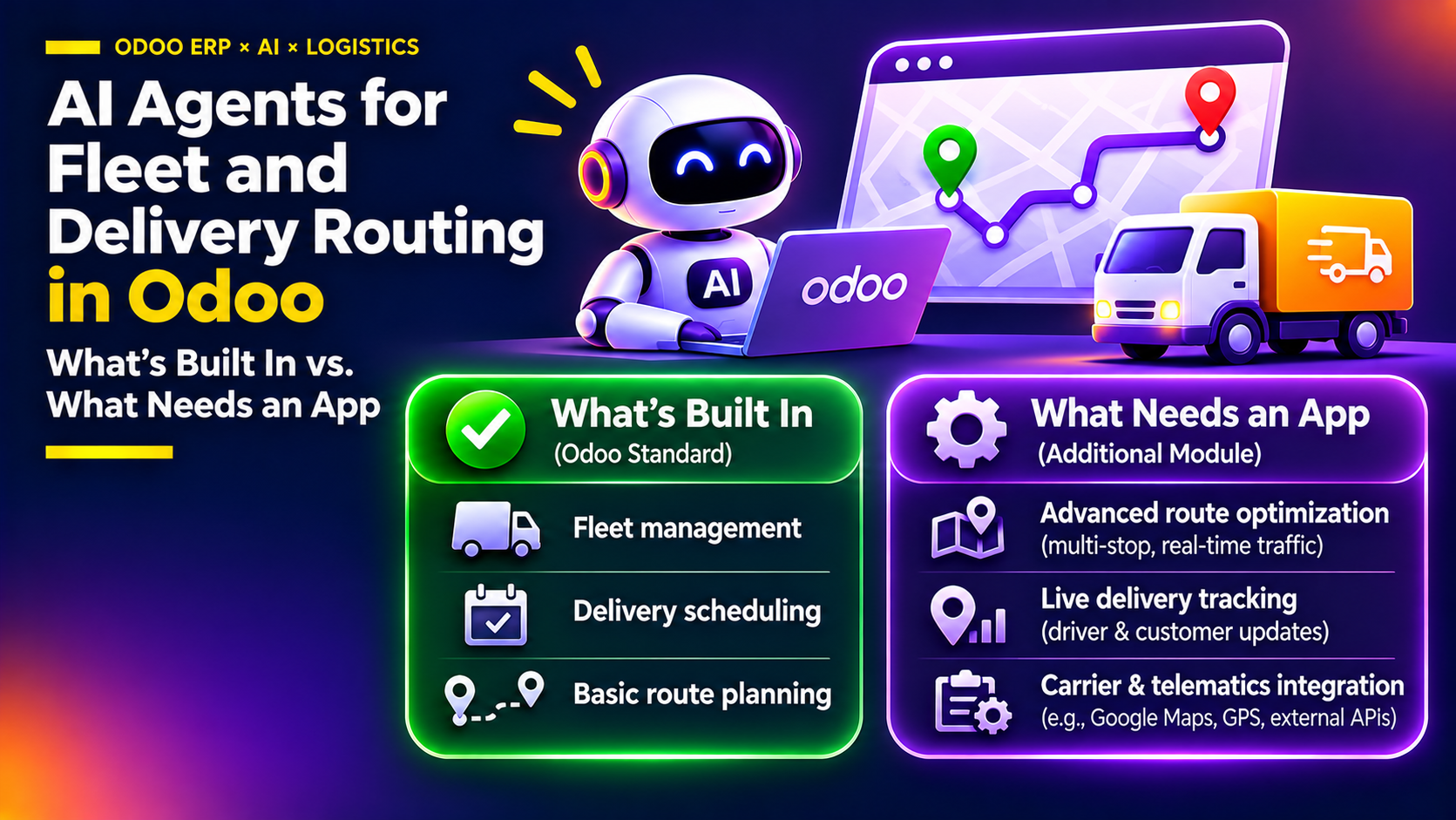
Odoo's Fleet app tracks vehicles, maintenance schedules, fuel and cost logging, and driver assignment. On the delivery side, Inventory and Sales handle delivery order creation, carrier integration for shipping label generation and tracking numbers, and basic delivery scheduling tied to stock availability. This covers the operational record-keeping and the connection between “an order is ready to ship” and “a delivery is created and tracked.”
What's Genuinely Not Built In
True multi-stop route optimization — calculating the most efficient sequence of stops across a fleet of vehicles, accounting for time windows, vehicle capacity, and real-time traffic — is not a native Odoo capability. This is a specialized logistics problem that dedicated routing tools and services are built specifically to solve, and the honest answer for a business with complex, high-volume routing needs is that a connected third-party routing tool, not Odoo alone, is the right tool for that specific job.
Where an AI Agent Fits In
Where an AI agent adds real value is in the layer between pure route optimization and the rest of the business — reasoning across Fleet, Inventory, and Sales data to answer questions a dedicated routing tool alone can't: “which deliveries are at risk of being late this week, and why” (a vehicle maintenance conflict, an order that wasn't ready on time, a driver shortage), or flagging when fleet capacity and today's delivery volume don't line up before it becomes a missed delivery window. This is the cross-module reasoning this blog describes elsewhere as the core difference between agentic AI and a single-purpose tool — it doesn't replace a dedicated routing engine, it connects the delivery picture to the rest of the business around it.
What This Looks Like, Illustrated
Illustrative example for explanatory purposes. Real flags depend on your own fleet and delivery data.
The Honest Takeaway
A logistics business evaluating Odoo should expect strong native handling of fleet records and delivery-order-to-tracking workflow, a genuine need for a dedicated routing tool for complex multi-stop optimization, and real added value from an AI agent in connecting the delivery picture to the rest of the business — rather than any one of these three doing all of the job alone.
Ready to Try It?
Want to see how Odoo's fleet and delivery tools fit your specific logistics setup? Book a Free Demo at hirebeans.cloud.
Book a Free Demo