
Introduction
A finished product's cost is only as accurate as its weakest sub-assembly estimate. In a multi-level bill of materials — where a finished good is built from sub-assemblies, which are themselves built from components — a cost increase two or three levels down can erode a product's margin silently, because nobody's watching that specific sub-assembly closely enough to notice until the finished product's cost report looks off months later.
Why This Specifically Gets Missed
A single-level BOM is easy to cost-check — the components and their prices are right there. A multi-level BOM compounds the problem: a price increase on a raw material rolls up through a sub-assembly, then rolls up again into the finished good, and by the time it's visible at the top level, it's been absorbed into several other cost movements and is hard to isolate. Odoo 19's BOM management added version control and cost simulation, which helps model a known change — but doesn't by itself catch a cost drift nobody flagged in the first place.
Where an AI Agent Fits In
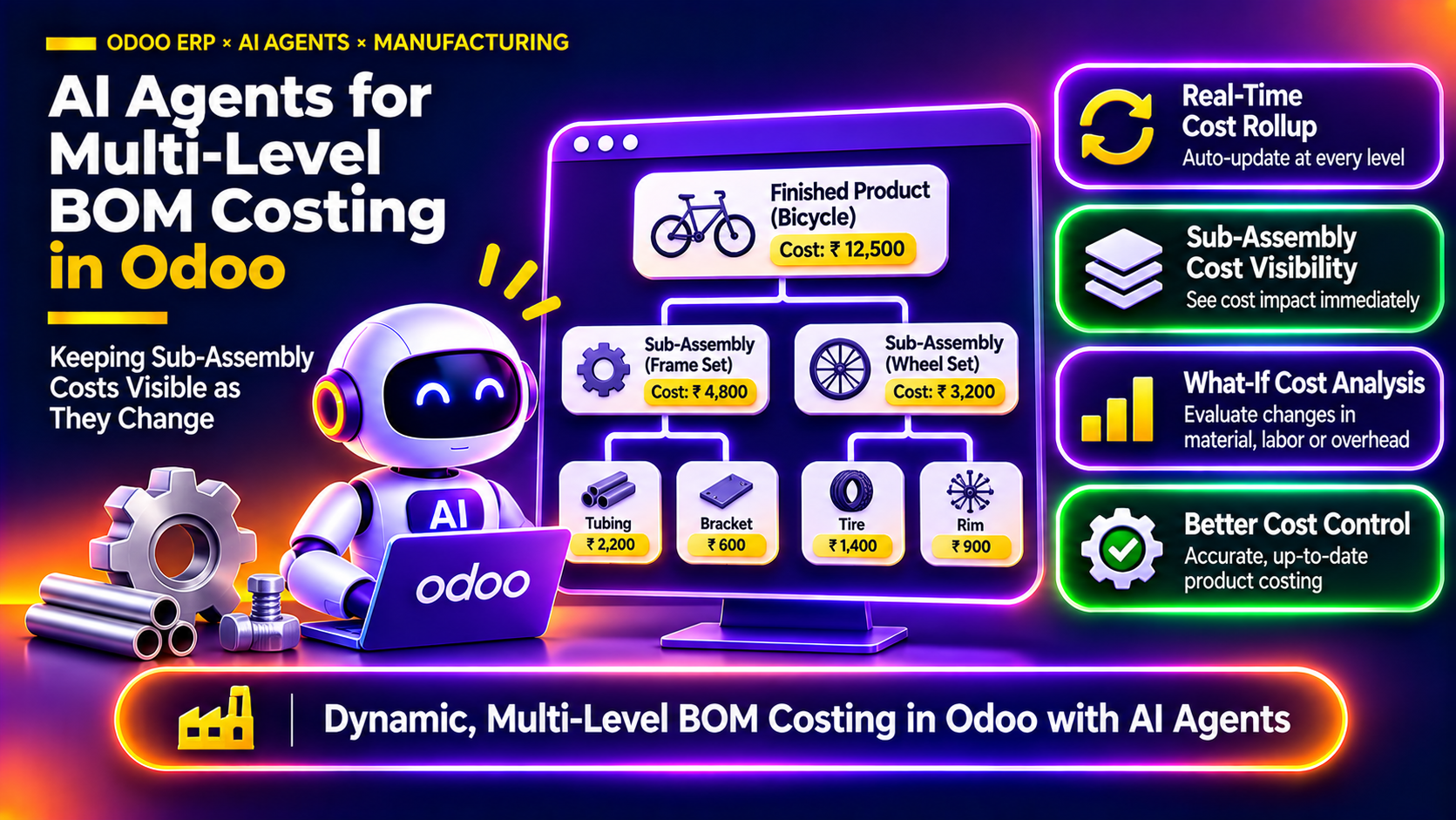
An AI agent reading Manufacturing and Purchase data can monitor cost inputs at every level of a BOM continuously, not just at the top, and flag which specific sub-assembly or component is driving a finished product's margin change — answering “why did Product X's cost increase this month” by tracing the actual driver down through the BOM levels, instead of a controller manually checking each level by hand.
This is a direct extension of the demand forecasting and reorder-point reasoning covered in this blog's look at AI agents in inventory — the same cross-module reasoning that flags a stockout risk can flag a cost-drift risk, because both depend on reading Purchase and Manufacturing data together rather than in isolation.
What This Looks Like, Illustrated
Illustrative example for explanatory purposes. Real cost attribution depends on your own BOM structure and purchase data.
Where This Still Needs a Decision
The agent surfaces where a cost change is coming from — it doesn't decide whether to absorb the increase, pass it to pricing, or source an alternative supplier. That's a margin and pricing decision for the business to make, now with a clear, specific answer about where the cost pressure is actually originating instead of a vague sense that costs are drifting.
Ready to Try It?
Want to see where cost drift is hiding in your own multi-level BOMs? Book a Free Demo at hirebeans.cloud.
Book a Free Demo