
Introduction
A distributor running multiple warehouses faces a routing decision on every single order: which warehouse should actually fulfill it. Get it wrong consistently — shipping from a farther warehouse when a closer one had stock, or splitting an order across two warehouses unnecessarily — and the cost shows up gradually, in shipping spend and delivery time, rather than as one obvious failure.
Why This Decision Is Harder Than It Looks
The “right” warehouse for a given order depends on several things at once: which locations actually have the stock, which is closest to the customer, current capacity or backlog at each location, and whether splitting the order across two warehouses is worth the extra shipping cost to avoid a partial delay. A person making this call manually, order by order, is weighing several variables under time pressure — which is exactly the condition under which a consistently suboptimal default (always ship from the main warehouse, say) tends to take over.
Where an AI Agent Fits In
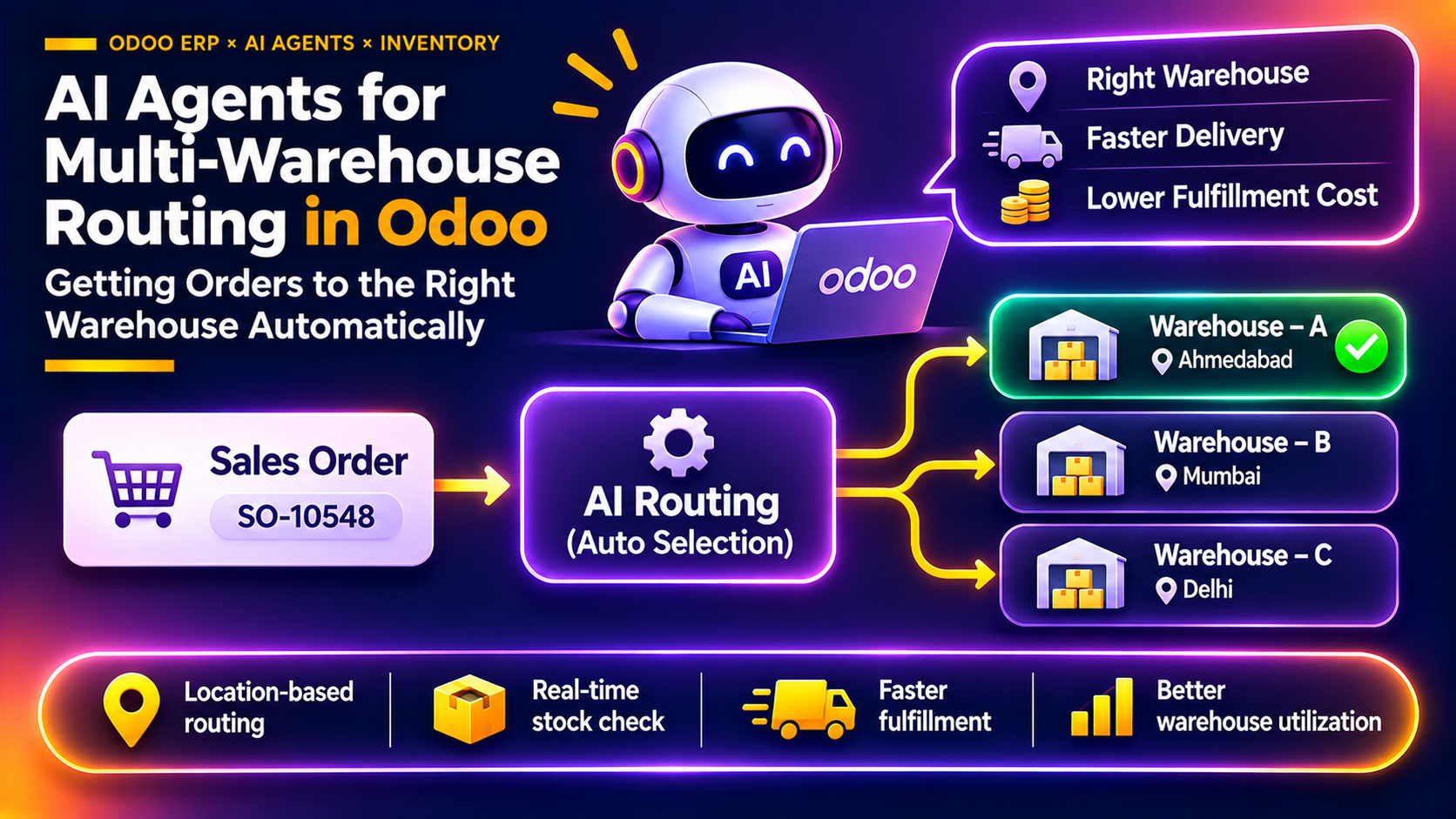
Odoo's multi-step routing configuration already defines the rules for how stock can move between warehouses. An AI agent reading live Inventory data across all locations can go further than static rules by reasoning about the current state — flagging when the default routing would ship from a warehouse that's actually out of stock or over capacity, and suggesting the warehouse that actually makes sense for that specific order right now, rather than a fixed rule applied blindly every time.
Asked directly, “which warehouse should fulfill this order, and why” is a cross-module question — reading current stock, location, and capacity together — consistent with how this blog describes agentic AI's core advantage over a static automation rule.
What This Looks Like, Illustrated
Illustrative example for explanatory purposes. Real routing recommendations depend on your own warehouse and order data.
Where a Person Still Decides
The agent surfaces a better routing option — a warehouse or logistics coordinator still confirms it, especially for exceptions like a customer-specific shipping agreement that overrides the general logic. The value is catching the routing inefficiencies a static rule misses, not replacing the judgment calls around genuine exceptions.
Ready to Try It?
Curious how your own multi-warehouse routing could be optimized? Book a Free Demo at hirebeans.cloud.
Book a Free Demo