
Introduction
Inventory problems are expensive in both directions: a stockout loses the sale and sometimes the customer; overstock ties up cash and warehouse space on products that aren't moving. Both are usually visible in the data well before they become a crisis — the problem is that nobody's watching every SKU closely enough, often enough, to catch the pattern in time.
What Gets Missed Without AI Assistance
A manual inventory review typically happens on a schedule — weekly, monthly — and covers whatever the team has time to check. A slow-building stockout risk on a mid-volume SKU, or a supplier's lead time quietly drifting longer over several orders, is exactly the kind of gradual pattern that a periodic manual check tends to miss until it's already a problem.
What an AI Agent Actually Does Here
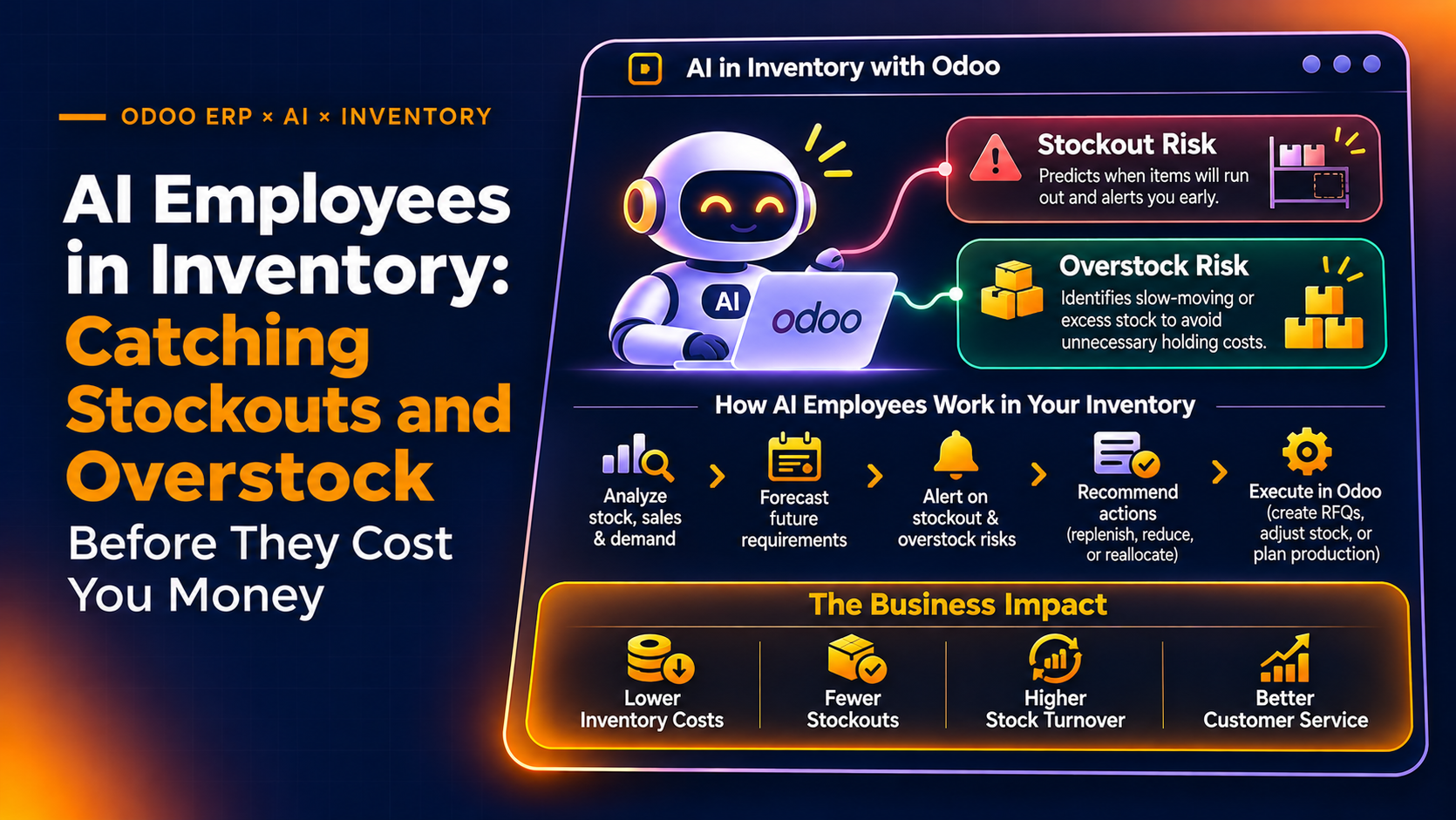
Odoo's inventory AI capability runs demand forecasting continuously rather than on a schedule — adjusting reorder points automatically as actual demand patterns shift, and learning supplier lead times from historical order data rather than relying on a static assumption entered once at setup. The practical effect is that reorder suggestions reflect what's actually happening now, not what was true when the parameters were last configured manually.
This connects directly to the kind of cross-module answer an AI agent can give on request — “which customer orders are at risk of late delivery, and why” — by reading Inventory alongside Manufacturing and Purchase in one pass, rather than a person manually checking all three.
Example: Three SKUs, Illustrated
Illustrative example for explanatory purposes. Real flags and recommendations depend on your own inventory and sales data.
Where This Still Needs a Person
An AI agent surfacing “this SKU is trending toward a stockout in 11 days” is useful precisely because it still hands the purchasing decision to a person — whether to expedite, whether to substitute a supplier, whether the trend is a real pattern or a one-off seasonal blip worth ignoring. The agent's job is making sure that decision gets made with 11 days of runway instead of zero.
Ready to Try It?
Want to see what's trending in your own inventory data? Book a Free Demo at hirebeans.cloud.
Book a Free Demo