
Introduction
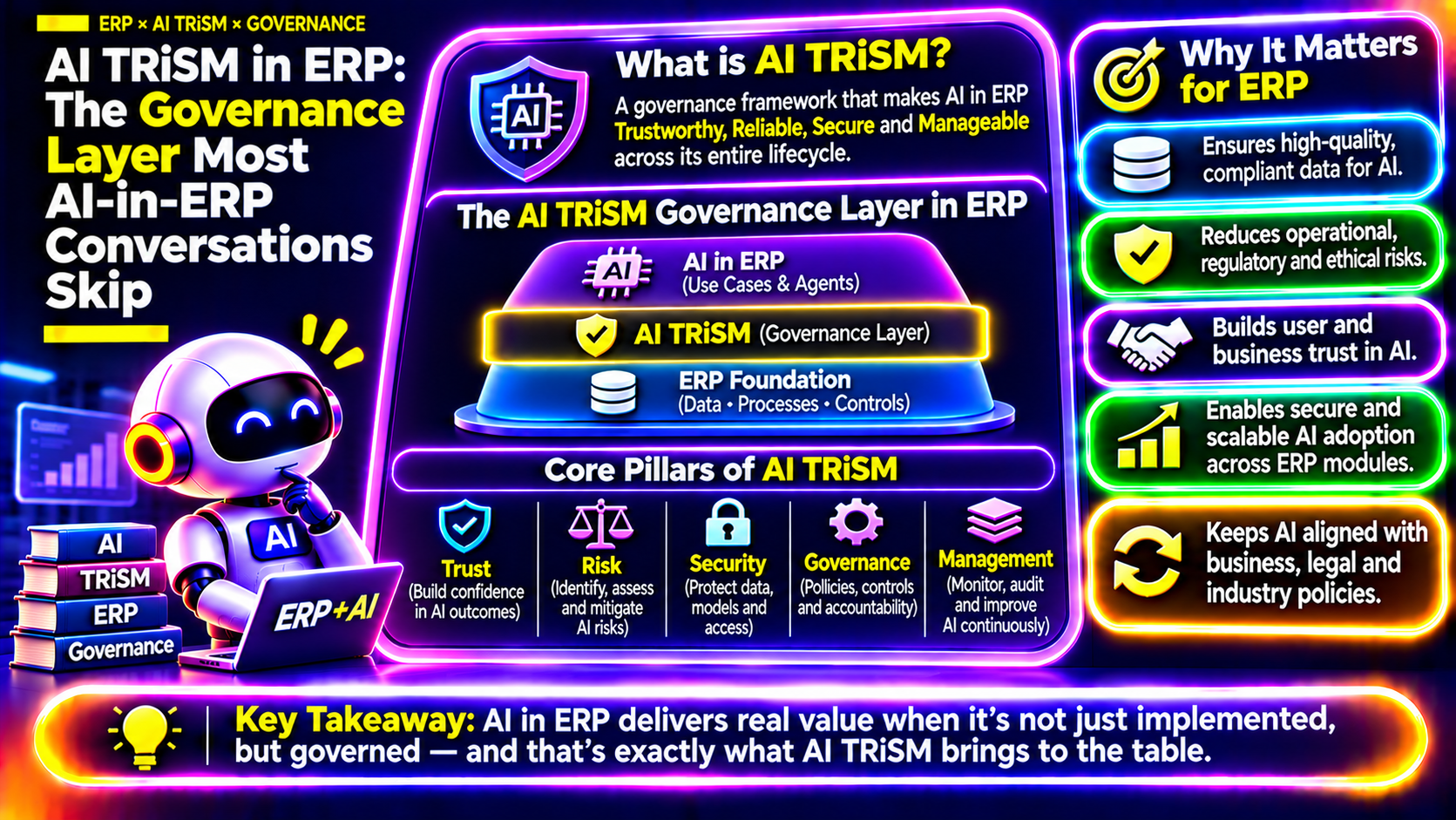
Most coverage of AI in ERP focuses on what the AI can do — forecast demand, draft a report, flag an anomaly. Gartner's own research names a fifth, less-discussed theme alongside those capabilities: AI TRiSM, short for AI Trust, Risk, and Security Management. It's the governance layer that determines whether an AI agent acting on your ERP data can be trusted to keep doing so safely as it scales, and it's where a lot of AI-in-ERP enthusiasm runs out of thinking.
What AI TRiSM Actually Covers
Per Gartner's own framing, AI TRiSM in cloud ERP finance applications centers on tools for AI-driven anomaly detection, continuous controls monitoring, and real-time audit logging — designed to guard against fraud, compliance breaches, and insider threats. Gartner's research also notes that both emerging and already-established TRiSM options exist in the market, meaning this isn't a purely theoretical category; it's an active product space vendors are building toward.
Why This Matters More as AI Agents Gain More Autonomy
The risk profile of AI in ERP changes as agents move from suggesting actions to taking them. A chatbot that drafts a report and waits for a human to send it carries limited risk if it's wrong. An agent that can create records, trigger payments, or update inventory — the direction Odoo's own AI agent capability is moving, as covered elsewhere on this blog — needs the oversight layer TRiSM describes, not as an afterthought but as part of how the agent is deployed from day one.
Where HireBeans Fits In
When we scope an AI Employees rollout on Odoo, defining exactly what an agent is permitted to do, and how that action gets logged and reviewed, is part of the Discovery phase, not a bolt-on after go-live. This is also why our implementation methodology includes a UAT (user acceptance testing) stage before full production use — it's where agent behavior gets validated against expected outcomes before it's trusted with live data unsupervised.
Want to talk through what oversight and audit logging should look like for your own AI agent rollout? Book a Free Demo at hirebeans.cloud.
Book a Free Demo