
Introduction
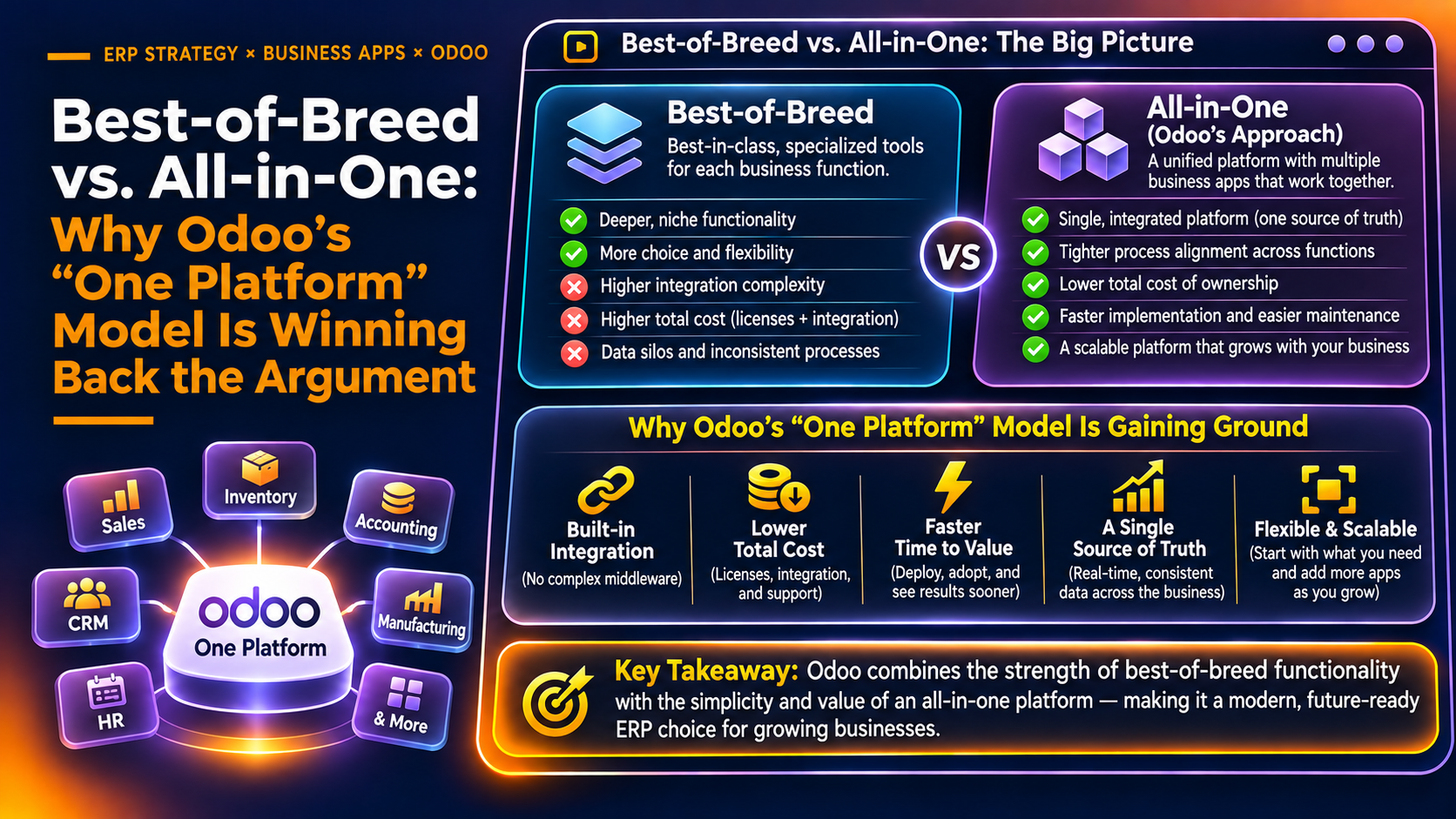
There's a real industry trend toward unbundling monolithic software suites into best-of-breed stacks — separate best-in-class tools for finance, HR, procurement, and each other function, stitched together through integrations. Lightspeed's Justin Overdorff describes this as enterprises moving away from single-vendor suites toward combining specialized tools. It's a genuine trend, and for large enterprises with dedicated integration teams, it can work well. For most small and mid-sized businesses, it quietly trades one set of problems for a worse one.
The Honest Case for Best-of-Breed
Point solutions can be genuinely best-in-class at their one job — a dedicated CRM built only for sales can out-feature a general CRM module, in isolation. Overdorff also notes that AI is creating room for new orchestration platforms that route tasks across multiple specialized tools with minimal human involvement — which is a real and interesting direction, but one that assumes mature integration infrastructure most SMBs don't have and can't easily build.
What the Trade-Off Actually Costs a Smaller Business
The case against best-of-breed for most SMBs isn't about feature quality — it's about what happens between the tools. Every integration between separate point solutions is a thing that can break, drift out of sync, or require ongoing maintenance that a business without a dedicated integration team doesn't have the bandwidth for. A CRM that doesn't share a database with the inventory system doesn't know an order is at risk of being unfulfillable. A finance tool stitched to five other apps via API connectors has five separate points of failure, five separate vendor relationships, and five separate places data can silently go stale.
Feature Comparison
| Factor | Best-of-breed stack | HireBeans (Odoo, connected) |
|---|---|---|
| Data consistency across departments | Requires integrations to sync; can drift out of sync | Single database — always current across apps |
| AI agent cross-department questions | Limited to what's been integrated and exported | Reads Sales, Inventory, Manufacturing, Purchase natively |
| Maintenance overhead | Multiple vendors, multiple integration points to maintain | One platform, one implementation partner, one upgrade path |
| Best-in-class depth per function | Often stronger in a single specialized area | Strong standard functionality; deep customization available where justified |
| Total cost of ownership at scale | Licensing plus integration build and maintenance cost | Platform licensing plus configuration; fewer moving parts |
Where Best-of-Breed Genuinely Makes Sense
This isn't an argument that all-in-one is always right. A business with one function that has truly unusual, highly specialized requirements — a niche compliance workflow, a highly specific manufacturing process — may still need a dedicated point solution for that one piece, connected to the core ERP rather than replacing it. The honest version of this argument is: default to a connected platform for the core of the business, and reach for a specialized point solution only where there's a documented, specific need a connected platform genuinely can't meet — the same discipline this blog has argued for around Odoo customization generally.
Ready to Try It?
Curious whether a connected platform or a point-solution stack fits your business better? Book a Free Demo at hirebeans.cloud.
Book a Free Demo