
Introduction
Gartner predicts that finance organizations using cloud ERP applications with embedded AI assistants will achieve a 30% faster financial close by 2028. That's a specific, published target, not a vague efficiency claim — and it's worth understanding what actually has to change in a finance function's processes to realistically move toward it, rather than treating it as something that happens automatically once an AI feature gets turned on.
The Target, Visualized
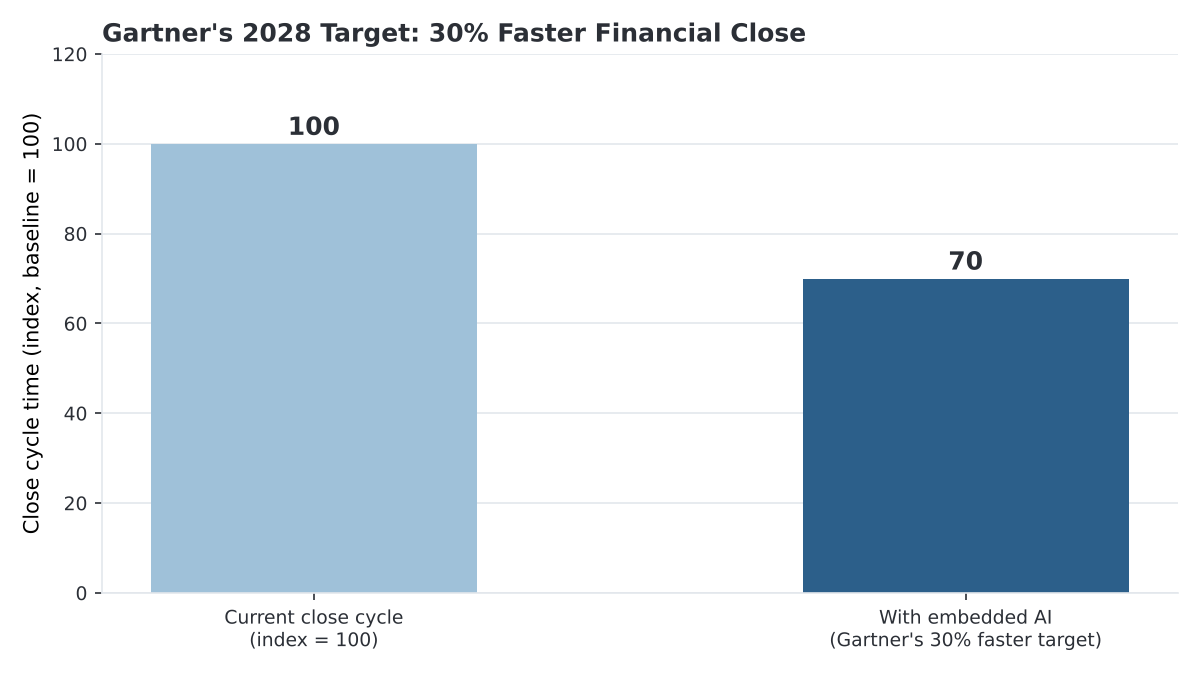
Illustrative index based on Gartner's published 30% faster close prediction; Gartner's forecast does not specify an absolute baseline close duration, which varies by company.
Gartner's own supporting research names intelligent process automation as the main mechanism behind this target — specifically, agentic AI, machine learning, and process orchestration applied to reconciliation and collections. Two concrete examples cited: autonomous transaction processing, where routine reconciliation work that used to require manual matching happens automatically, and AR collections that predict payment behavior and optimize working capital rather than simply tracking what's overdue after the fact.
What "Continuous Close" Actually Changes Day to Day
Laid out side by side, the shift looks less like a single feature and more like a change in rhythm across the whole close process:
Why This Can't Be Layered on a Shaky Foundation
Gartner's own adoption data is a useful check here: AI-enabled solutions are forecast to reach 62% of cloud ERP spending by 2027, but the same research notes most CFOs are still early in adoption, citing data quality, integration complexity, and skills gaps as barriers — the identical pattern covered in this blog's broader posts on the AI adoption funnel and top adoption barriers. A continuous close built on inconsistent, poorly integrated transaction data doesn't produce a faster close; it produces faster, more confident errors.
Where HireBeans Fits In
Moving toward a continuous close in Odoo starts with the same groundwork covered throughout this blog: clean, consistent transaction data, well-defined chart of accounts and reconciliation rules, and a clear view of which exceptions genuinely need human judgment versus which can be automated safely. We scope this as a defined phase of an AI Employees finance rollout, not a single feature toggle.
Want to understand realistically how much faster your own close process could get, and what it would take? Book a Free Demo at hirebeans.cloud.
Book a Free Demo