
Introduction
ERP hosting used to be a fairly simple choice between “on-premise” and “the cloud.” That's no longer true. Geopolitical tensions and tightening regulation — particularly across Europe, Asia-Pacific, and increasingly elsewhere — are pushing organizations to think specifically about where their data physically sits, not just whether it's hosted remotely. Gartner's guidance on this has shifted from a general cloud recommendation to advising businesses to build an explicit sovereignty strategy based on legal, industry, and workload requirements.
What “Data Sovereignty” Actually Means in Practice
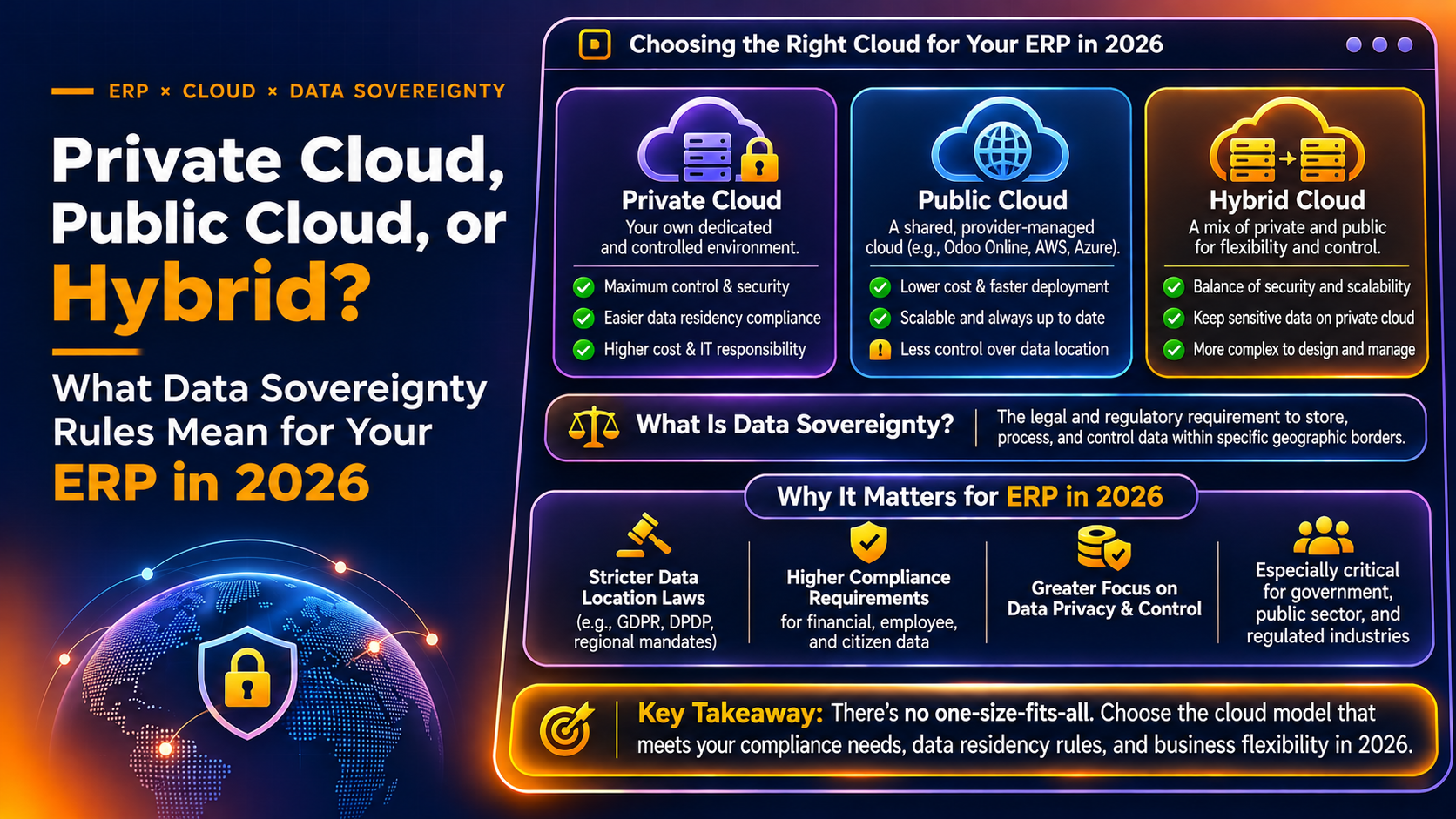
Data sovereignty is the principle that data is subject to the laws of the country it's physically stored in, regardless of where the company using it is headquartered. For a business running ERP, this matters most in regulated sectors — healthcare, finance, government contracting — and for any business operating across borders where customer or financial data needs to stay within a specific jurisdiction to comply with local law.
The Three Models, Explained Without the Marketing Spin
- ✓Public cloud: hosted on shared infrastructure by a large provider, typically the most cost-efficient and fastest to deploy, but with less direct control over exactly where data physically resides unless the provider offers region-specific hosting guarantees.
- ✓Private cloud: dedicated infrastructure, either self-managed or managed by a partner, giving direct control over physical location and configuration — at a higher cost and with more operational responsibility, which is why it's seeing renewed growth specifically in regulated industries like banking and healthcare.
- ✓Hybrid: a mix — sensitive data and workloads kept on private or regional infrastructure, less sensitive workloads on public cloud. Forrester notes this has become the default model in many regulated environments, not a compromise but a deliberate choice.
How This Applies to a Business Choosing Odoo Hosting
For most small and mid-sized businesses outside tightly regulated sectors, public cloud hosting remains the sensible default — cost-efficient, fast to deploy, and sufficient for the vast majority of use cases. The sovereignty question becomes genuinely important in a narrower set of situations: handling healthcare or financial data subject to specific regional regulation, operating in a jurisdiction with strict data residency law, or serving government or enterprise clients who contractually require it.
The practical takeaway from Gartner's guidance isn't “move to private cloud.” It's to actually check, specifically, whether your industry or your customers' contracts require a sovereignty commitment — before defaulting to whatever hosting model is easiest to set up.
Ready to Try It?
Not sure which hosting model fits your compliance requirements? Book a Free Demo at hirebeans.cloud.
Book a Free Demo