
Introduction
SAPinsider's 2026 benchmark data found that 55% of SAP customers have deployed S/4HANA or SAP Cloud, but only 34% have fully transitioned to it. In the same research, plans to adopt SAP's Joule AI copilot rose more than 40% year over year — a sharp increase in adoption intent, even as the underlying platform transition it depends on remains incomplete for a majority of SAP's own customer base. This isn't a criticism specific to SAP; it's a pattern worth understanding before any company, on any ERP platform, layers an AI copilot onto a platform transition that isn't actually finished.
The Gap Between Deployed and Transitioned
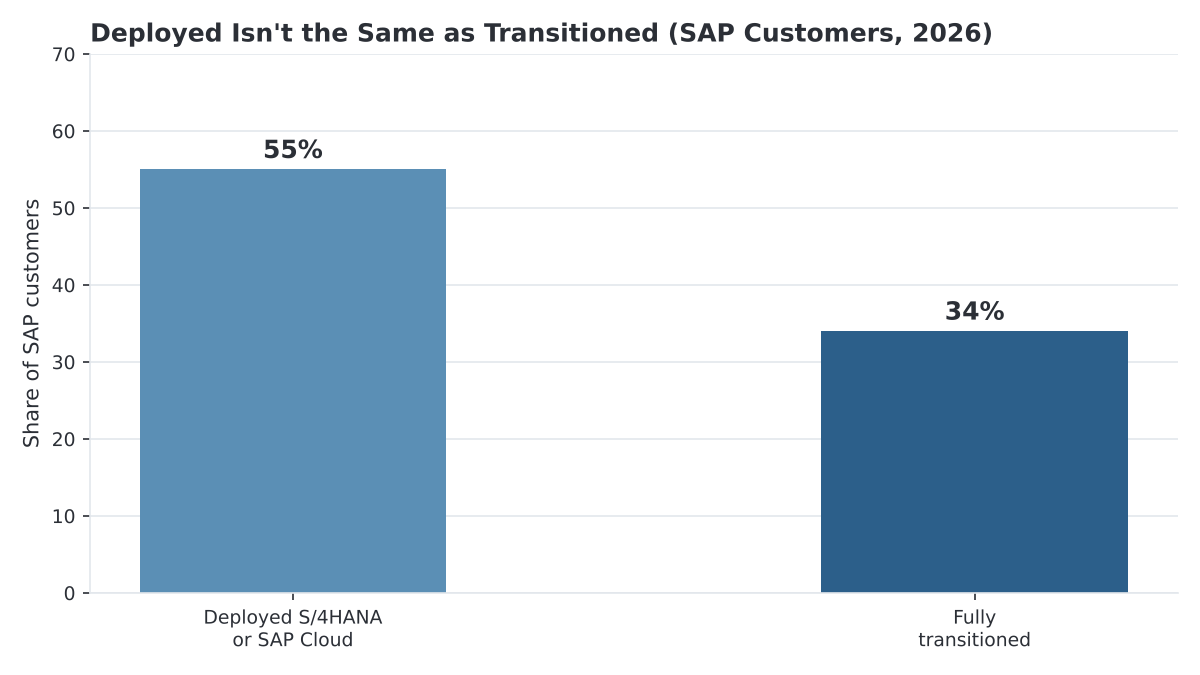
Source: SAPinsider 2026 benchmark data, as reported by erp.today's coverage of the ERP AI skills gap.
“Deployed” in this context typically means the new platform is live and technically running. “Fully transitioned” means the organization has actually moved its processes, data, and ways of working onto it — old workarounds retired, teams trained, legacy dependencies cleaned up. A 21-point gap between those two states means a meaningful share of “deployed” SAP customers are still operating in a hybrid, partially-transitioned state, which is a less stable foundation for an AI copilot than a fully settled one.
Why This Matters for the Joule Adoption Surge Specifically
A copilot like Joule is designed to work across an organization's live business processes — which means its usefulness depends on those processes actually being consistent and settled on the new platform, not still partially running on old workarounds alongside it. The research cited elsewhere in this series on SAP's broader AI skills gap found that 91% of organizations use AI at some level, but only 17% have embedded it in core workflows — the same deployed-versus-transitioned gap showing up again, one layer up the stack.
The Lesson for Any ERP Buyer, Including Odoo Users
The pattern here isn't SAP-specific — it's a sequencing lesson that applies to any ERP platform layering AI capability onto an incomplete transition. Odoo's own AI agent capabilities, covered throughout this blog, carry the same implicit dependency: they work best when the underlying Odoo implementation is actually complete and settled, not mid-migration or running alongside legacy workarounds. A rising interest in AI copilots, on any platform, is worth checking against a more basic question first: is the platform transition underneath it actually finished.
Where HireBeans Fits In
This is a direct argument for the implementation sequence we follow — go-live and a stabilization period before layering on AI Employee capability, rather than introducing both at once. It's also a reason we ask, as part of Discovery, whether a client's existing Odoo instance (if there is one) is a fully settled implementation or a partial one still carrying legacy workarounds, since that answer changes how we'd scope an AI rollout.
Not sure whether your own ERP implementation is fully transitioned enough to support an AI layer well? Book a Free Demo at hirebeans.cloud.
Book a Free Demo