
Introduction
SAP Business Suite 7 support ends December 31, 2027. Microsoft Dynamics GP support ends September 30, 2029. These aren't projections — they're published end-of-life dates. What makes them urgent rather than distant is the other number in this picture: ERP cloud migrations typically take 18 to 36 months from decision to completion, according to industry reporting on CIO planning around these deadlines. Measured against a December 2027 deadline from today, that migration window is already tight for anyone who hasn't started.
The Deadlines on a Calendar
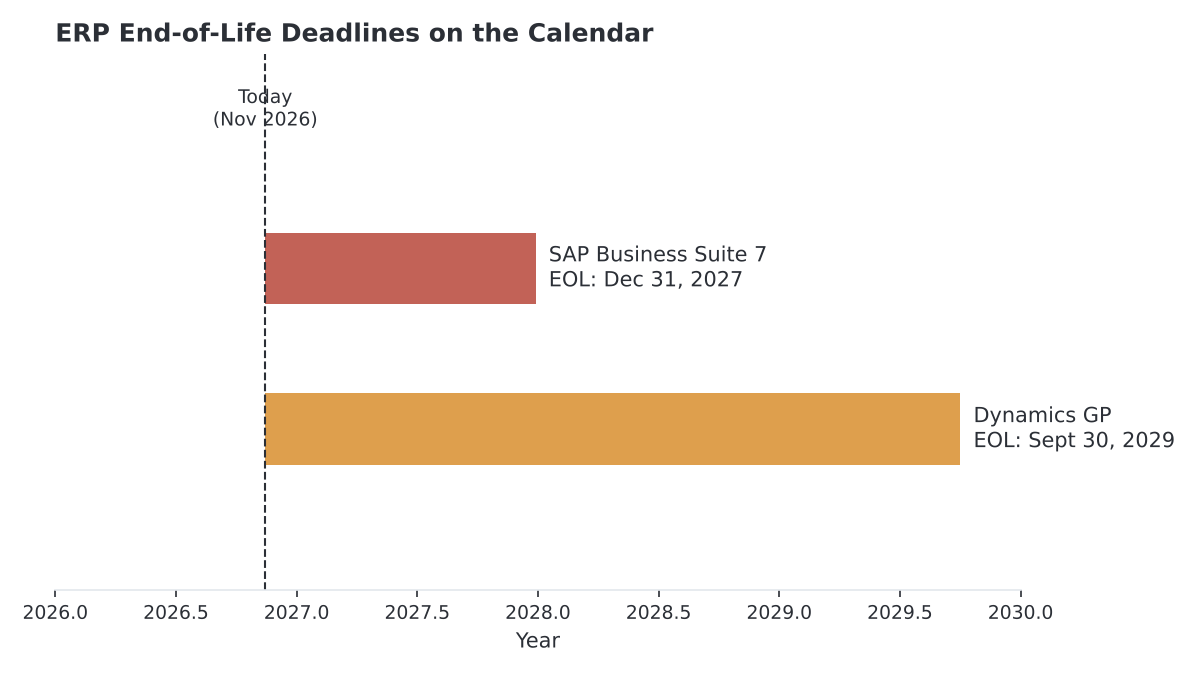
EOL dates per CIO.com's 2026 ERP trends reporting. Bar lengths show the deadline dates on a timeline from today; migration duration is a separate, typical-range estimate, not a prediction for any specific project.
Morgan Stanley's research, cited in the same reporting, estimates that 60–70% of SAP's support base has not yet moved to the cloud — meaning a large share of SAP customers are implicitly on a clock that a meaningful portion of them haven't started responding to yet. The same research found that 50% of CIOs surveyed plan to upgrade or modernize their ERP systems in the next few years, which is a reasonable response to this deadline pressure, but “planning to” and “having started” are different positions to be in as the deadline approaches.
Why the Decision Can't Wait Until the Deadline Gets Closer
The math is straightforward once laid out: if a migration genuinely takes up to 36 months, and the deadline is just over a year away as of this writing, waiting much longer to decide doesn't leave room for a full migration before support ends — it leaves room only for an emergency, compressed one, which tends to carry more risk, not less. The decision isn't really “migrate or don't” at this point for SAP Business Suite 7 customers; it's “migrate to the cloud on the current platform, or evaluate switching platforms entirely” — and either path needs to start now to fit inside the remaining window.
Where HireBeans Fits In
This is exactly the decision point we work through with businesses evaluating a move off a legacy or end-of-life ERP — including the related question we've covered in depth elsewhere on this blog: whether to migrate onto the latest supported version of your current platform, or use the forced decision point as a reason to evaluate switching to Odoo outright. Either way, the clock in the chart above is the same clock, and starting the evaluation now is what keeps both options genuinely open.
On the clock for an end-of-life deadline and not sure which path fits your business? Book a Free Demo at hirebeans.cloud.
Book a Free Demo