
Quick Answer
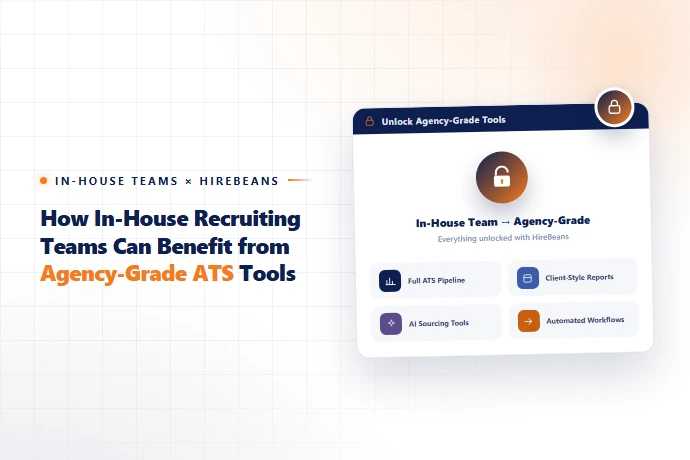
In-house recruiting teams benefit from agency-grade ATS tools because agency software is built around the exact pressure in-house recruiters increasingly face: multiple simultaneous open roles, multiple internal "clients" (hiring managers) with different expectations, and pressure to report time-to-fill and pipeline health clearly. Traditional corporate HRIS-attached ATS tools are often built for compliance and volume hiring, not for the fast-moving, relationship-driven workflow a recruiter juggling 15 open roles across 8 hiring managers actually needs day to day.
Why This Shift Is Happening
In-house recruiting teams have grown more complex over the last few years: leaner talent acquisition teams, more open roles per recruiter, and hiring managers who expect agency-level responsiveness and communication. At the same time, many corporate ATS platforms were designed primarily around compliance workflows — EEO reporting, requisition approval chains, candidate disclosures — rather than the day-to-day mechanics of sourcing, pipeline management, and stakeholder communication that agency recruiters have always had to master.
What "Agency-Grade" Actually Means in Practice
- ✓Treating each hiring manager like a client. Agency ATS platforms are built around managing multiple "client" relationships (job orders) simultaneously, which maps directly onto managing multiple hiring managers with competing priorities.
- ✓SLA tracking per role. Agencies track delivery timelines because clients expect it. In-house teams increasingly need the same discipline to answer "why is this role still open" conversations with data instead of anecdotes.
- ✓Faster resume screening and shortlisting. AI-assisted resume scoring, built for agencies fielding high applicant volume per role, works just as well for an internal team drowning in applications for a popular posting.
- ✓Self-serve candidate scheduling. Removing scheduling admin from the recruiter's plate matters just as much internally as it does for an external agency.
Agency ATS vs. Traditional Corporate ATS
Capability | Traditional Corporate ATS | Agency-Grade ATS (e.g. HireBeans) |
|---|---|---|
Primary design goal | Compliance, approval workflows, high-volume applicant intake | Speed, relationship management, delivery tracking |
Multi-stakeholder job tracking | Often limited to a single hiring manager per requisition | Built for managing many simultaneous "clients" (job orders) |
SLA/delivery tracking | Rarely native | Built in per role |
AI resume screening | Varies, often an add-on | Built in |
Setup and admin overhead | Often requires HRIS/IT involvement | Designed for fast, self-serve setup |
What to Evaluate If You're an In-House Team Considering This Shift
- ✓1. Can it handle your requisition volume without a heavy admin layer? Agency tools are built for speed, but confirm they can still support whatever approval workflow your organization requires.
- ✓2. Does it support internal stakeholder reporting? You'll want to show hiring managers and leadership the same kind of pipeline visibility an agency shows its clients — see our guide on recruitment KPIs worth tracking.
- ✓3. Is pricing sustainable as your requisition load grows? The same flat-rate vs. per-seat question that matters for agencies (see why HireBeans doesn't charge per recruiter) matters just as much for a growing in-house team.
- ✓HireBeans explicitly supports in-house recruiting teams as one of its core solution paths, alongside recruitment agencies and staffing firms — built on the same underlying platform rather than a stripped-down version.
Explore the In-House Solution
See how HireBeans supports in-house recruiting teams, or start a free 30-day trial to test it against your own requisition load.