
Introduction
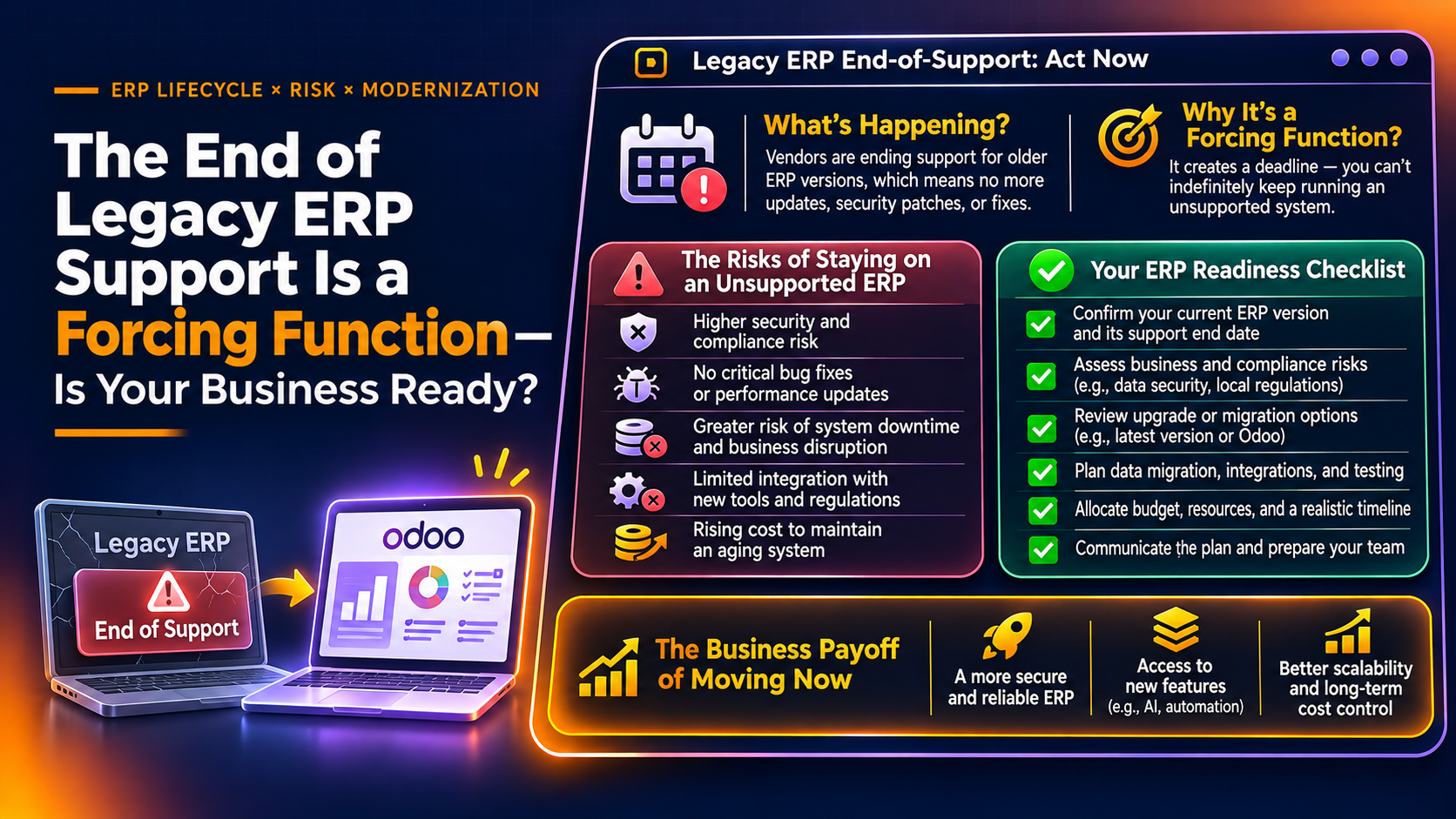
Most ERP replacement decisions get postponed indefinitely — the current system “mostly works,” the migration looks disruptive, and there's always a more urgent priority. Vendor end-of-support deadlines remove that option by force. SAP is ending support for Business Suite 7 at the end of 2027. Microsoft is ending support for Dynamics GP in 2029. Morgan Stanley's Simon Clark calls this kind of deadline a “forcing function” for cloud migration — and the math on timing is less forgiving than it looks.
Why This Matters Even If You're Not on SAP or Dynamics
These two deadlines are the most publicly visible examples, but they're symptoms of an industry-wide pattern, not an isolated case: major ERP vendors are consistently moving their customer base toward cloud-native, AI-ready architectures, and sunsetting older on-premise or legacy product lines to do it. A business on any aging, heavily customized legacy ERP — regardless of vendor — should expect a similar deadline eventually, even if it hasn't been announced yet.
Dates as publicly announced by each vendor as of 2026; always confirm current status directly with the vendor before planning around a specific date.
Why the Timeline Is Tighter Than It Looks
A full ERP migration — discovery, data migration, configuration, testing, training, go-live — typically takes 18 to 36 months for a mid-sized business, even under reasonable conditions. That means a business planning around a 2027 or 2029 end-of-support date needs to be starting that process now, or very soon, not waiting until the deadline is visibly close. Waiting until a system is actually unsupported means running a production business on a system no longer receiving security patches, with a migration still ahead and under far more time pressure.
The Cost of Waiting Until the Deadline Forces It
A planned migration, started with runway, allows for a proper discovery phase, a phased rollout, and realistic testing before go-live — the same conditions that separate a successful implementation from a failed one, covered elsewhere on this blog. A migration forced by an imminent end-of-support date compresses all of that into less time, under more pressure, which is exactly the profile of project most likely to repeat the common Odoo implementation failure patterns: underspecified scope, rushed discovery, no real governance.
What to Actually Do With This Timeline
Check your current ERP's publicly stated support roadmap now, regardless of vendor — most publish this, and it's rarely checked until it becomes urgent. If a deadline exists within the next three to five years, start the evaluation and discovery process well ahead of it, not at the midpoint. And if no formal deadline exists yet but the system is already old, heavily customized, and hard to find support for, treat that as an informal version of the same forcing function — the deadline existing on paper isn't actually the thing that matters; the system's practical end-of-life is.
Ready to Try It?
Not sure how much runway you actually have before a migration becomes urgent? Book a Free Demo at hirebeans.cloud.
Book a Free Demo