
Introduction
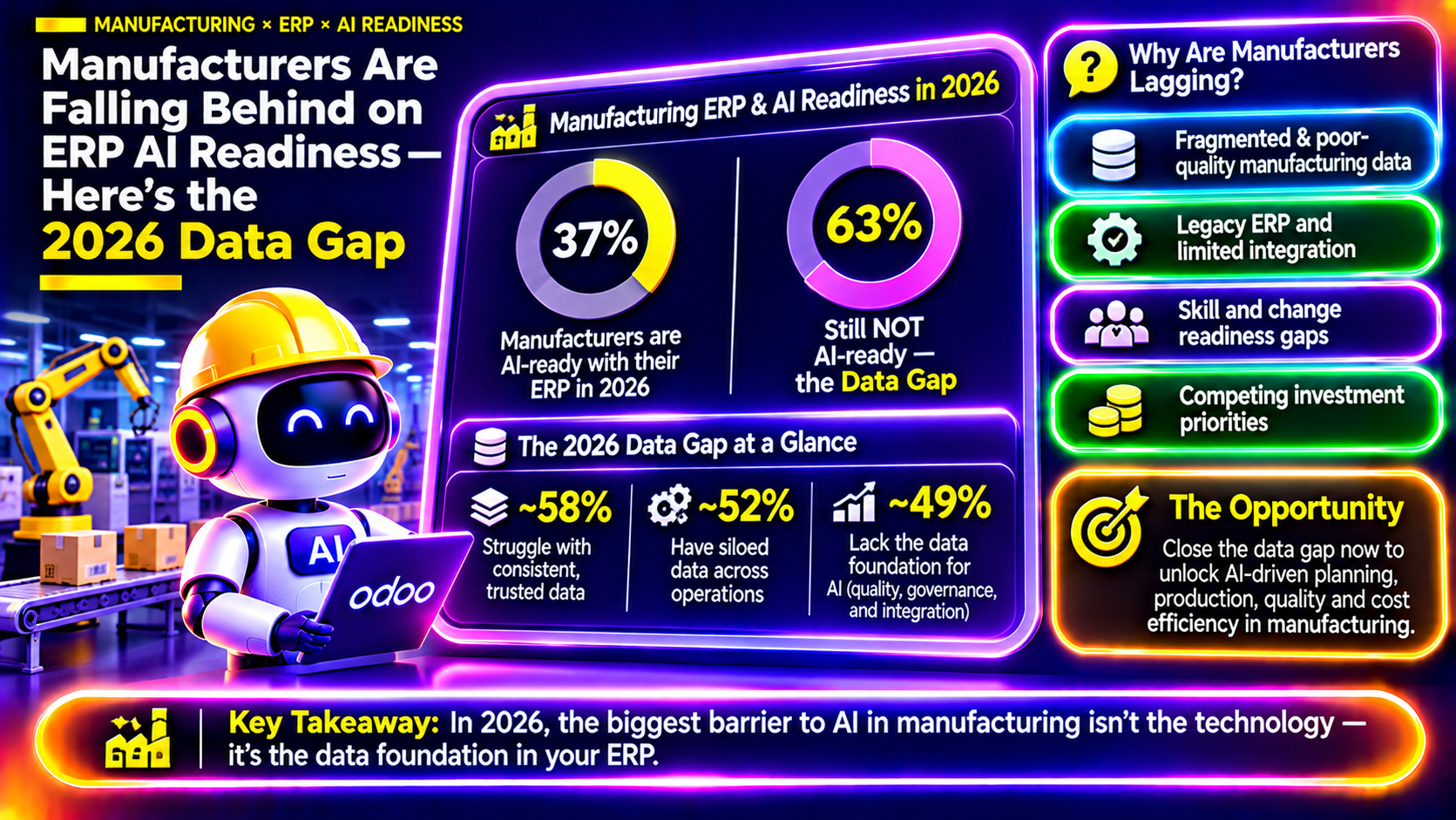
A 2026 survey breakdown of manufacturers specifically, within the broader mid-market ERP AI adoption data covered elsewhere in this blog, found a readiness gap worth examining on its own: 55% of manufacturers name legacy system integration as their top AI barrier, compared to 41% across the mid-market generally. Only 27% of manufacturers have a data warehouse or data lake, compared to 60% of the broader mid-market. 45% work from siloed data. Despite this gap, 91% of manufacturers still plan to increase AI spending.
The Gap, by the Numbers
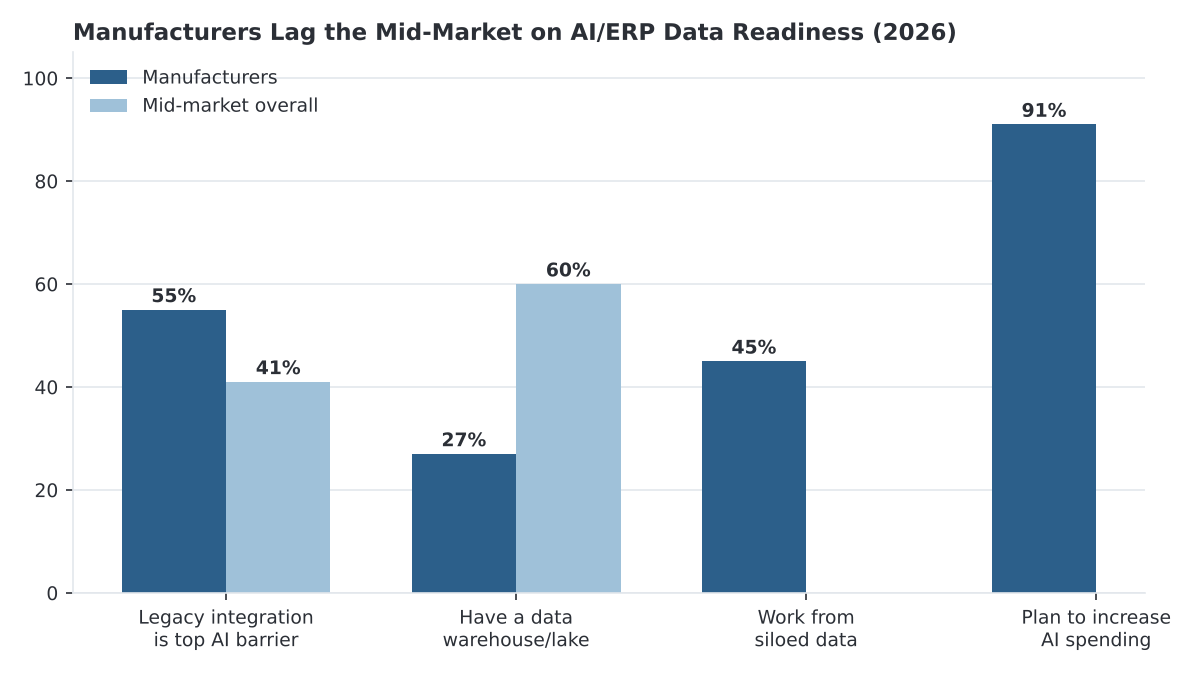
Source: Netrio and Kaufman Rossin 2026 survey data, manufacturing segment, as compiled by KORE1's State of Mid-Market ERP AI Adoption report.
The combination here is specific: manufacturers are more likely than the general mid-market to cite integration as their top barrier (55% vs. 41%), and substantially less likely to have the data infrastructure — a data warehouse or lake — that would typically help address it (27% vs. 60%). That's a 33-point infrastructure gap sitting underneath a 14-point barrier-perception gap, which suggests the infrastructure shortfall is real and not just a perception issue.
Why Manufacturing Specifically Tends to Have This Problem
Manufacturing environments commonly run a wider spread of specialized systems than many other industries — separate MES (manufacturing execution systems), quality management tools, equipment-specific software tied to specific machinery, and the core ERP itself, often accumulated over years as different production lines or facilities adopted different tools. That spread is a structural reason integration shows up as a bigger barrier here than in industries with simpler, more centralized system landscapes.
The Encouraging Part of This Data
A 91% intent-to-increase-spending figure despite a 33-point infrastructure gap is, read generously, a signal that manufacturers recognize the problem and are prepared to invest in solving it — which is a better starting position than a sector that's both behind and unmotivated to close the gap. The risk, per the broader investment-gap pattern covered elsewhere in this blog, is that spending increases without first closing the data-warehouse gap tend to produce the same “spending ahead of results” pattern seen industry-wide.
Where HireBeans Fits In
This data closely matches what we see directly in manufacturing implementations — fragmented systems across production lines, facilities, or equipment generations, with no consolidated data layer underneath. Our manufacturing-focused implementation work, covered in more operational detail in this blog's dedicated manufacturing AI posts (batch recall readiness, shift scheduling, multi-level BOM costing), starts with exactly this consolidation step, because the survey data here confirms it's the specific gap holding the sector back from its own stated AI spending intentions.
Want to see what closing this specific infrastructure gap would look like for your own manufacturing operation? Book a Free Demo at hirebeans.cloud.
Book a Free Demo