
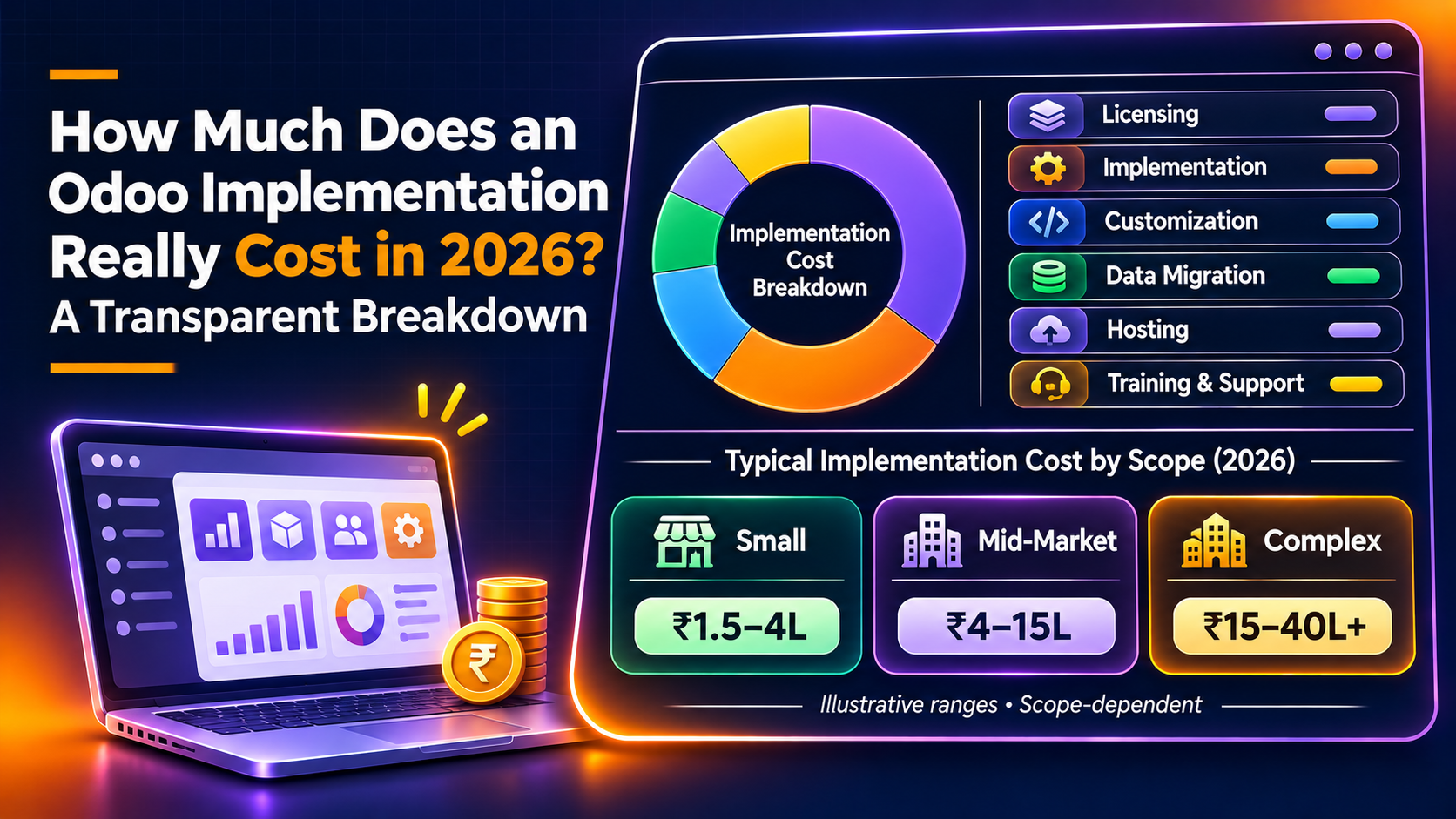
Introduction
“It depends on scope” is the honest answer to “how much does Odoo cost,” and it's also not a very useful one if you're trying to budget. This is a transparent breakdown of typical 2026 market rates by business size, pulled from published industry cost guides — treated as indicative ranges, since your actual cost depends on your specific modules, data complexity, and customization decisions.
Typical Implementation Cost by Business Size
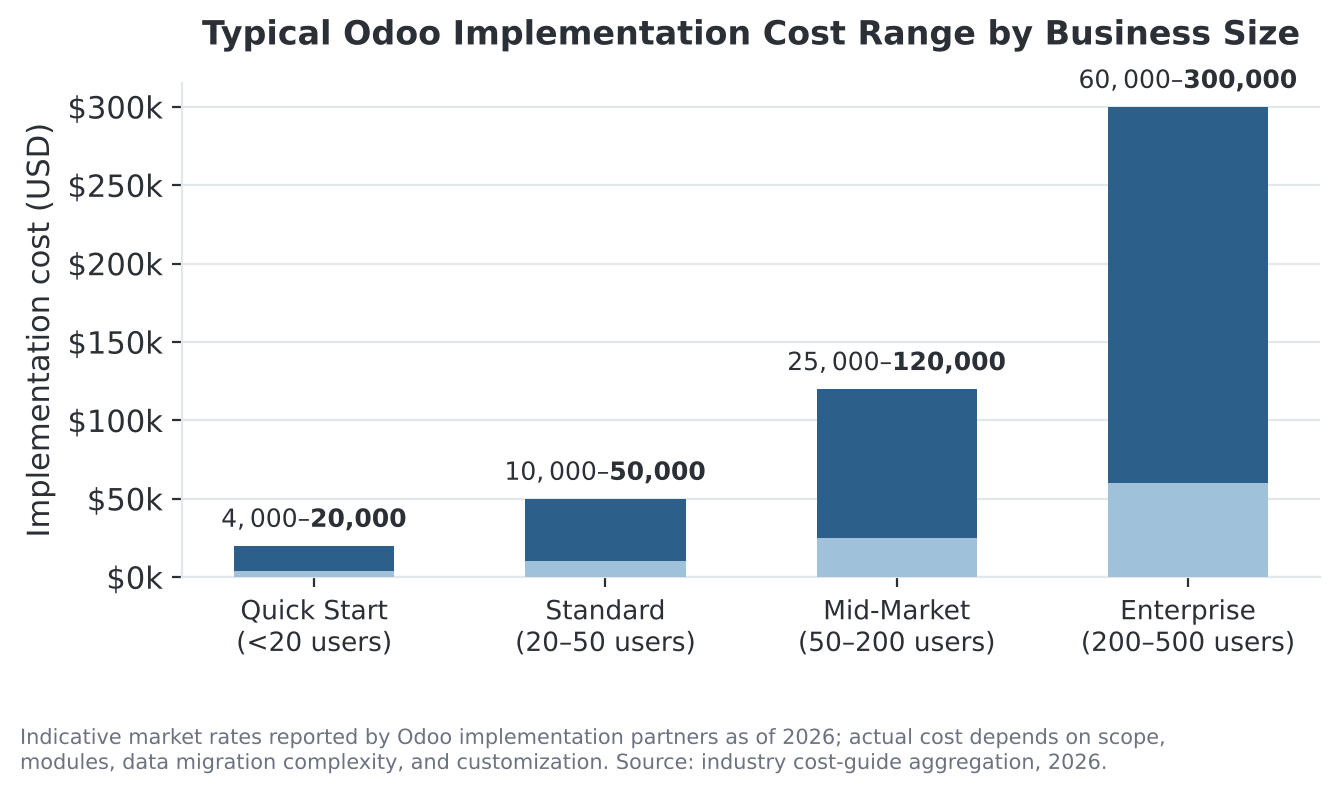
Chart — typical Odoo implementation cost range by business size.
Indicative market rates reported by Odoo implementation partners, as of 2026. Actual cost depends on your specific scope.
What's Actually Inside That Number: A Mid-Market Example
For a representative 50-user, 6-module mid-market implementation, year-one cost typically breaks down roughly as follows:
Illustrative mid-market template; your own breakdown will shift based on module count, customization depth, and data complexity.
The Costs Most Budgets Miss
- ✓A few cost categories consistently get underestimated at the budgeting stage, worth planning for explicitly rather than discovering mid-project:
- ✓Customization: Studio-level configuration work typically runs $500–$5,000 per item; genuine custom module development runs $2,000–$30,000 per module; third-party integrations typically run $3,000–$20,000 each. This is also exactly where the over-customization cost trap covered elsewhere on this blog starts — every one of these is a recurring upgrade cost, not a one-time expense.
- ✓Data migration: A simple migration can run $2,000–$5,000, but migrating from a legacy ERP with messy or undocumented historical data can run $25,000–$80,000 — a wide enough range that it's worth an honest early assessment of your existing data's condition, not a generic estimate.
- ✓Post-go-live reality: Post-go-live support commonly runs $2,000–$8,000 in the immediate aftermath, with ongoing annual maintenance of $3,000–$12,000, and version upgrades every two to three years typically running $5,000–$30,000 — all of which are easy to leave out of an initial budget focused only on getting to go-live.
Result-Based vs. Hourly: Why the Engagement Model Matters as Much as the Number
The total cost figures above are a starting point, not a quote — how a partner structures the engagement affects your actual risk, not just the price. A result-based model (deposit to start, build and demo against agreed outcomes, balance on delivery) suits a business with a clear, firm scope and go-live goal. An hourly model suits support, enhancement, and evolving-scope work after go-live, where flexibility matters more than a fixed number. Asking which model a prospective partner defaults to, and why, is often more revealing than asking for a single bottom-line quote.
Ready to Try It?
Want a transparent, scoped estimate for your own implementation? Book a Free Demo at hirebeans.cloud.
Book a Free Demo