
Introduction
When an Odoo implementation stalls, the instinct is to blame the software. It's the visible thing — the screens people are frustrated with, the reports that don't match expectations, the workflow that feels clunkier than the spreadsheet it replaced. But Odoo runs over 5 million users across more than 100 countries. If the software itself were the core problem, that number wouldn't exist.
The more useful — and more uncomfortable — question is whether the problem is actually the implementation, and by extension, the partner who ran it.
Two Very Different Decisions, Often Made as One
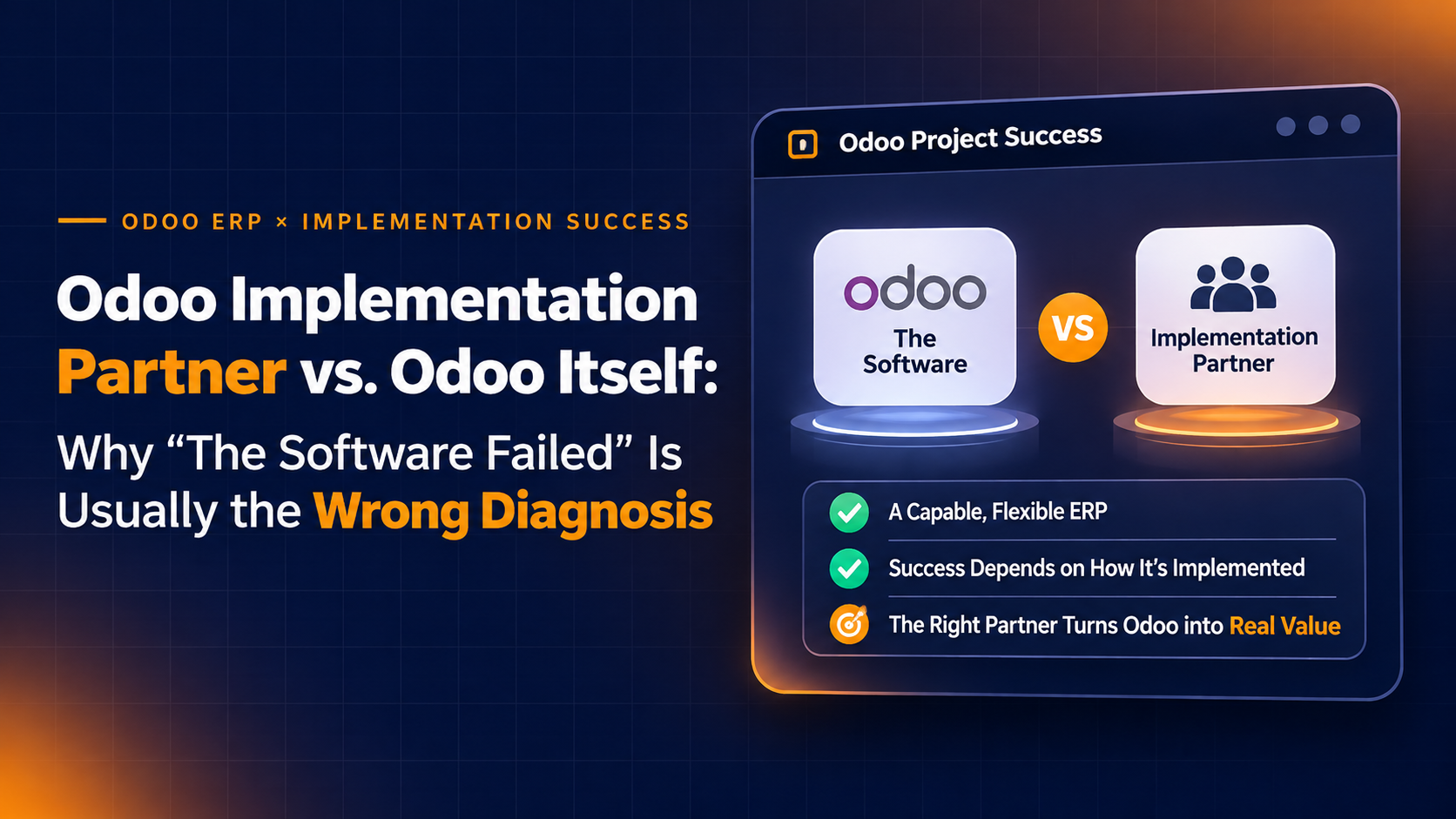
Choosing “Odoo” and choosing “who implements Odoo for us” feel like a single decision during a sales process, but they're not. The software is a platform: a standard set of apps — Sales, Inventory, Accounting, Manufacturing, HR — all sharing one database. What determines whether that platform actually fits your business is how well someone translated your actual operations into that platform's configuration. That's a services decision, not a software decision, and it's where most of the variance in outcomes actually lives.
How to Tell Which One Is Actually Broken
- ✓A few diagnostic questions help separate the two:
- ✓Does the system technically work, but nobody trusts it? That's usually an implementation symptom — data wasn't migrated cleanly, a workflow was configured to match a demo instead of your real process, or training never happened. Not a software defect.
- ✓Are you hitting a feature that genuinely doesn't exist in Odoo, even with configuration or a reasonable app? That's rarer, and it's a real software-fit question worth escalating.
- ✓Did the project start without anyone mapping your actual business processes first? If scope was built from a feature checklist instead of your workflows, the resulting build was never going to match how your teams work — regardless of how capable the underlying software is.
- ✓In practice, the overwhelming majority of “Odoo doesn't work for us” complaints trace back to the second and third questions, not the first.
What to Actually Vet When You're Choosing a Partner
- ✓Since the partner — not the platform — is where most of the risk sits, here's a short framework for evaluating one before you sign anything:
- ✓Ask for the named person who will architect your implementation, with their delivered-project history. Not a company bio — a specific human.
- ✓Ask how discovery works. A partner who can describe, in detail, how they map your processes before configuration is a different category of partner than one who starts quoting modules on the first call.
- ✓Ask how change requests get scoped. Projects without a defined process for handling new requirements drift, and drift is where budgets and timelines quietly die.
- ✓Ask what happens after go-live. Implementation and support are often sold separately; know the handoff before you need it.
- ✓Ask for references in your industry and size, not just logos. A retailer's Odoo build and a manufacturer's Odoo build solve very different problems with the same platform.
A Single Point of Contact Changes the Risk Profile
A large share of the warning signs above trace back to one root cause: no one person owns the project from start to finish. When discovery, build, testing, and support are handled by different people with no single accountable owner, requirements get lost in translation at every handoff. A dedicated point of contact — someone who was on the discovery call and is still answering your questions a year into support — removes most of that translation risk by default.
Odoo being “the wrong ERP” is a real conclusion sometimes — but it should be the last conclusion you reach, after ruling out discovery gaps, governance gaps, and partner quality. Most projects that feel like a software failure are, on closer inspection, an implementation one.
Ready to Try It?
Want a second opinion on your Odoo partner or project? Book a Free Demo at hirebeans.cloud.
Book a Free Demo