
Structuring the Factory Floor
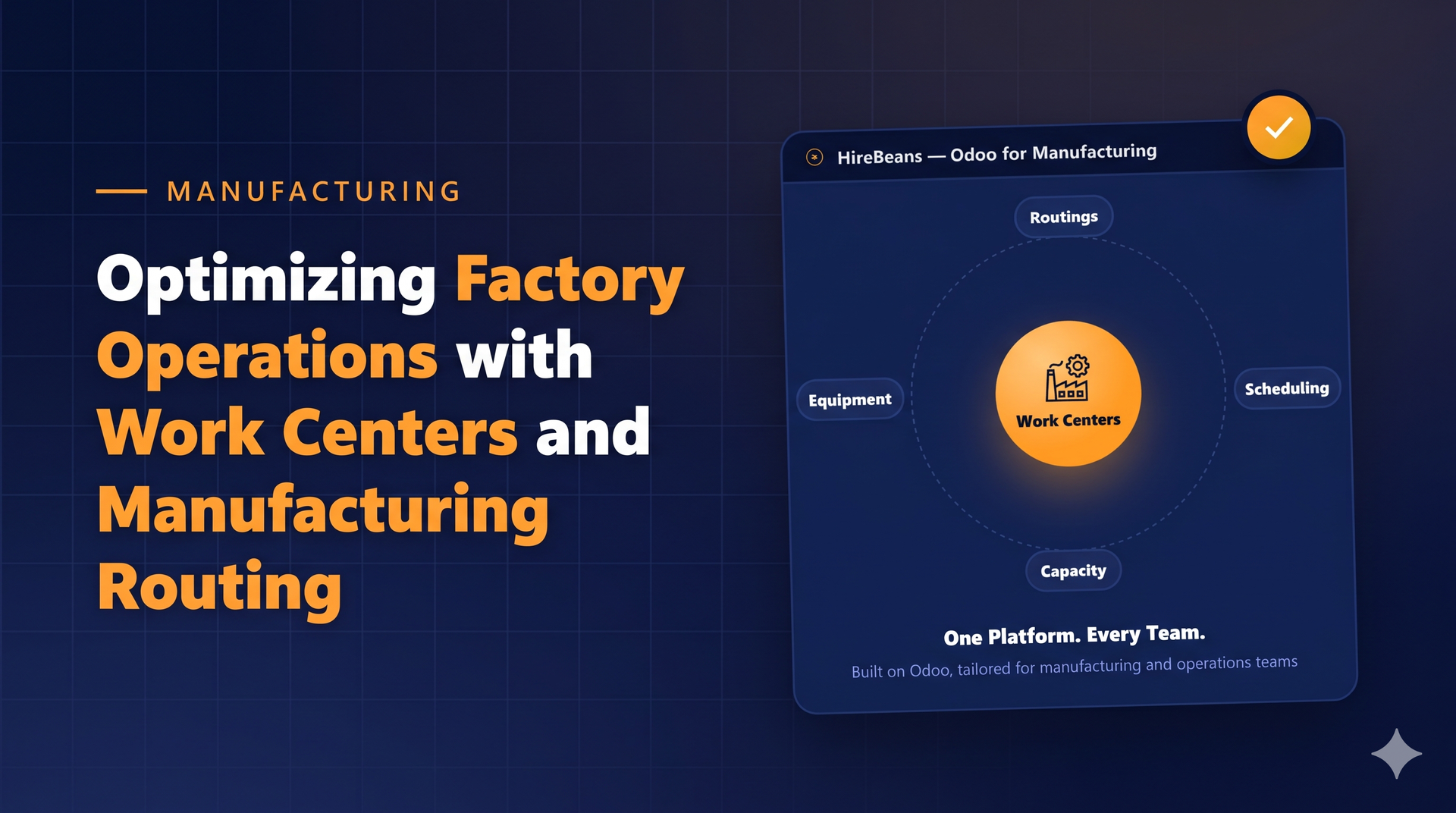
As manufacturing operations scale, relying on a generalized 'production floor' is no longer sufficient. Businesses must organize their factory into highly defined work centers—specific physical locations, machines, or groups of employees where specialized tasks occur, such as CNC machining, welding, painting, or quality testing. Paired with this is production routing, the precise sequence of operations that dictates exactly how a product moves from one work center to the next.
The Bottleneck Dilemma
When production routing is undefined, efficiency plummets. Products pile up at certain workstations while others sit idle. Managers lack the data to identify exactly where the bottlenecks are occurring, making it impossible to improve throughput. Without structured work order management, employees are left confused about production responsibilities, leading to inconsistent quality and wasted time as they figure out 'what to do next'.
Key Features: Streamlining Operations in Odoo
A Practical Business Example
Consider an electronics manufacturer producing customized server racks. The process involves metal cutting, electrical assembly, rigorous software testing, and final packaging. By utilizing defined work centers, the production routing strictly ensures that a rack cannot be sent to the packaging center until the testing center has digitally signed off on it. This clearly defines employee responsibilities at each stage, prevents premature processing, and allows managers to see immediately if a backlog is forming at the testing station.
Conclusion
While simply configuring work centers in software will not automatically optimize factory performance, enforcing disciplined production routing and accurate time tracking creates a framework for continuous improvement, revealing hidden inefficiencies and enabling better resource planning.
Ready to eliminate bottlenecks on your factory floor? Book a Free Demo at hirebeans.cloud
Book a Free Demo