
Quick Answer
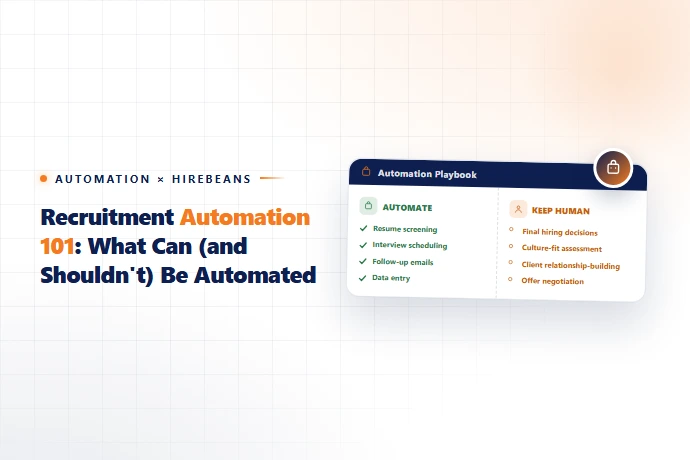
Recruitment automation works best on repetitive, low-judgment tasks — resume parsing, candidate data entry, interview scheduling, status update emails, and initial screening against clear criteria. It works poorly, and can actively damage candidate experience and placement quality, when applied to tasks requiring judgment and relationship-building — final candidate evaluation, sensitive client conversations, and offer negotiation. The agencies getting the most value from automation are automating the administrative layer of recruiting, not trying to automate recruiting itself.
Why "Automate Everything" Is the Wrong Goal
Recruitment automation software is often marketed as a way to remove human involvement from as much of the hiring process as possible. In practice, the agencies that get the best results treat automation as a way to remove administrative burden from recruiters — freeing up time for the parts of the job that genuinely require human judgment, not replacing that judgment entirely. Automating the wrong step doesn't just fail to help; it can actively hurt candidate experience and placement quality.
What Should Be Automated
- ✓Resume Parsing and Data Entry
- ✓Manually transcribing resume data into structured fields is repetitive, error-prone, and adds zero judgment value. This is a clear automation win — see our breakdown of how automated resume parsing eliminates manual data entry.
- ✓Initial Screening Against Objective Criteria
- ✓Filtering candidates against clear, objective requirements (years of experience, required certifications, location) is a rules-based task well suited to automation, freeing recruiters to spend their attention on the shortlist rather than the full applicant pool.
- ✓Interview Scheduling
- ✓Self-serve scheduling removes one of the most time-consuming back-and-forth tasks in recruiting, with no loss of candidate experience — if anything, most candidates prefer the convenience.
- ✓Status Update Communication
- ✓Automated "your application has moved to the next stage" or "thank you for applying" messages keep candidates informed without requiring a recruiter to manually send dozens of individual updates.
- ✓SLA and Deadline Tracking
- ✓Flagging when a role is approaching its SLA deadline is exactly the kind of monitoring task automation handles better than manual tracking — consistent, and immune to a busy week causing something to slip.
What Should Not Be Fully Automated
- ✓Final Candidate Evaluation
- ✓AI-assisted scoring is genuinely useful for narrowing a large applicant pool to a strong shortlist, but the final call on which candidate to submit to a client should stay with a recruiter who understands the nuance a resume can't fully capture — team fit, communication style, career motivation.
- ✓Sensitive Client and Candidate Conversations
- ✓Delivering a rejection, negotiating a counter-offer, or managing a client's shifting requirements requires human judgment and relationship management that automated messaging can't replicate without damaging trust.
- ✓Offer Negotiation
- ✓Compensation discussions involve reading nuance, building trust, and sometimes real-time flexibility that scripted or automated communication handles poorly.
- ✓Strategic Sourcing Decisions
- ✓Deciding where and how to source for a genuinely hard-to-fill role benefits from a recruiter's judgment and market knowledge — automation can execute a sourcing plan efficiently, but shouldn't be the one designing the strategy for a nuanced search.
A Simple Framework: Administrative vs. Judgment-Based
Task Type | Automate? | Examples |
|---|---|---|
Repetitive, rules-based, low-judgment | Yes | Resume parsing, scheduling, status updates, SLA tracking |
Requires pattern-matching at scale | Partially (AI-assisted, human-reviewed) | Initial resume screening, skill-based shortlisting |
Requires relationship, nuance, or negotiation | No | Final candidate selection, offer negotiation, sensitive conversations |
How This Plays Out in a Real Recruitment Tech Stack
The best recruitment software doesn't force an all-or-nothing choice — it automates the administrative layer while keeping recruiters firmly in control of judgment calls. This is the same principle behind AI-powered recruitment features built for agencies: AI narrows and ranks, but a recruiter still decides who gets submitted. For a fuller picture of which features fall into which category, see our guide on what recruitment agency software should actually do.
Automate the Right Things
HireBeans automates resume parsing, screening, scheduling, and SLA tracking — while keeping recruiters in control of final decisions. Start a free 30-day trial to see the balance in action.