
Quick Answer
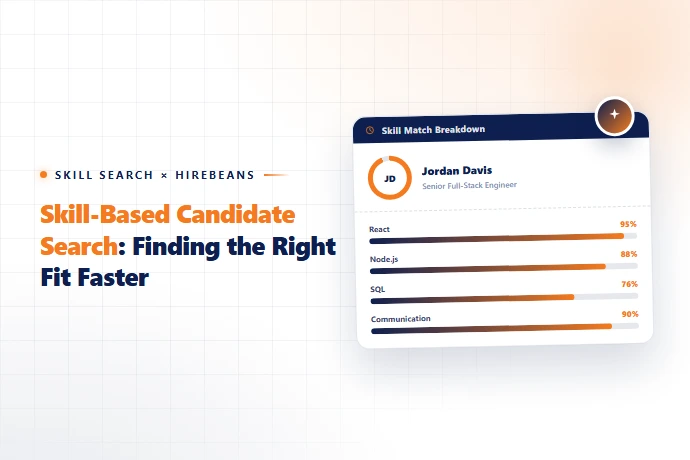
Skill-based candidate search lets recruiters find candidates by matching the specific skills a role requires — not just job titles or keywords buried in a resume. Instead of searching "Senior Java Developer" and hoping the right people used that exact title, a recruiter searches for the underlying skills (Spring Boot, microservices, AWS, 5+ years) and gets every candidate who has them, regardless of what their previous title happened to be. This surfaces stronger, more relevant matches faster and reduces the number of irrelevant resumes a recruiter has to manually screen.
Why Job-Title Search Quietly Fails Recruiters
Job titles are inconsistent across companies, industries, and even departments within the same company. One company's "Senior Software Engineer" is another's "Staff Engineer" or "Lead Developer" — despite near-identical responsibilities and skill sets. A recruiter searching by title alone systematically misses strong candidates whose previous employer simply used different language, and just as often surfaces weak matches whose title looked right but whose actual skills don't fit the role.
Keyword search on full resume text is a marginal improvement, but it still returns false positives — a resume that mentions "Python" once in a list of tools the candidate briefly touched ranks the same as a candidate with five years of daily Python development. Skill-based search solves both problems by treating skills as structured, weighted data rather than incidental text.
How Skill-Based Search Actually Works
- ✓Structured skill extraction at intake. When a resume is parsed, skills are pulled out as distinct, structured data points — not left buried in unstructured text. This is one of the direct benefits of automated resume parsing: the system captures skills consistently, without relying on a recruiter to manually tag every resume.
- ✓Weighted matching, not binary matching. A candidate with 5 years of a required skill should rank above one with 6 months of exposure to the same skill — good skill-based search accounts for depth, not just presence.
- ✓Synonym and adjacency handling. Strong systems understand that "React.js" and "React" are the same skill, and that someone strong in Vue.js may be a reasonable stretch candidate for a React role, even without an exact match.
- ✓Cross-referencing against the job order, not a static database. The best implementations let a recruiter search directly against a specific job order's required skills, surfacing ranked matches from the existing candidate database instantly.
Skill-Based Search vs. Traditional Search Methods
Method | What It Matches On | Main Weakness |
|---|---|---|
Job-title search | Literal title text | Misses candidates with different titles for equivalent roles |
Full-text keyword search | Any mention of a keyword anywhere in the resume | No sense of depth or relevance — a passing mention ranks like real expertise |
Skill-based search | Structured, weighted skill data tied to experience depth | Requires good resume parsing at intake to work well |
What This Means for Time-to-Fill
The practical impact of skill-based search shows up directly in time-to-fill and submission-to-placement ratio — two of the KPIs worth tracking closely (see our full guide to recruitment agency KPIs). When a recruiter can pull a ranked shortlist of genuinely qualified candidates from an existing database in seconds, instead of starting a fresh sourcing search or manually reviewing dozens of resumes, the entire pipeline moves faster — particularly valuable when filling a role that closely resembles one you've filled before.
What to Look for When Evaluating This Feature
- ✓1. Does skill extraction happen automatically at resume intake, or does a recruiter need to manually tag skills after the fact?
- ✓2. Can you search directly against a job order's requirements, not just run a generic keyword search separately?
- ✓3. Does the system rank by relevance and depth, or just return every partial match with no meaningful ordering?
- ✓4. Does it handle skill synonyms and adjacent skills intelligently, or require exact-match terms only?
- ✓These questions pair well with the rest of our 15-question recruitment software buyer's guide and our breakdown of what recruitment agency software should actually do.
How HireBeans Handles Skill-Based Search
HireBeans combines automated resume parsing with structured skill-based search as part of its core feature set, so recruiters can search the existing candidate database against a job order's exact requirements rather than starting from a blank keyword search every time. This is one of the features that also powers HireBeans' AI-powered candidate matching.
Try It on Your Own Candidate Database
Start a free 30-day trial of HireBeans and run skill-based search against your own job orders, no credit card required.