
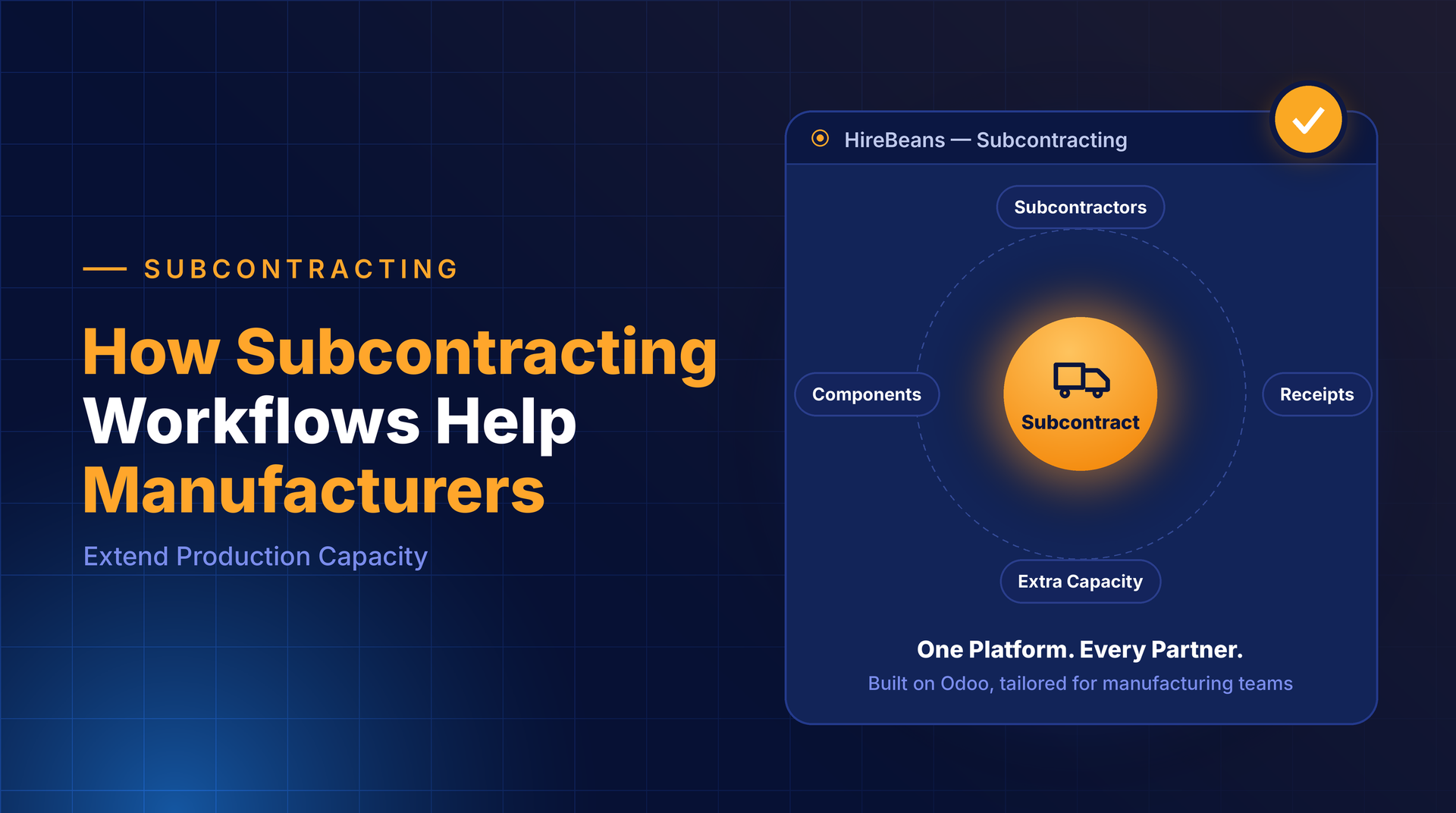
Introduction
Few manufacturers do everything in-house. Plating, heat treatment, stitching, or final assembly may be handled by specialist partners, particularly when demand rises beyond your own capacity. Subcontracting is a practical way to extend what you can produce, but it creates a visibility problem: your materials are now at someone else's premises.
This article explains how subcontracting works in Odoo Manufacturing and how to keep track of components and finished products while a partner does the work.
The Challenge
Informal subcontracting relies on trust and memory. Components are sent to a partner with a delivery note, and a phone call confirms the order. When the finished goods return, someone checks quantities and updates stock. If the partner returns fewer items than expected, or if scrap occurs, there is often no clear record of how many components were sent and what happened to them.
Costs are also difficult to follow. Material, processing charges, and transport are recorded in different places, so the real cost of a subcontracted item is unclear. And because stock held at the partner is not visible in the system, planners may think they have components that are actually committed elsewhere.
Key Features
A Real-World Example
- ✓Consider a bicycle components company that makes steel frames in-house and uses a partner for powder coating and final assembly. Frames and hardware are sent to the partner, who returns assembled, coated units.
- ✓The company enables subcontracting and creates a subcontracting BoM listing the frame, paint, and hardware needed for the finished unit, with the partner named as the subcontractor. When a purchase order is created for a batch of finished bicycles, Odoo plans the movement of components to the partner, depending on the resupply settings. The warehouse sends the components and records the transfer.
- ✓When the partner delivers the finished bicycles, the team receives them against the purchase order. This completes the subcontracted manufacturing and updates the finished product stock. The processing fee on the purchase order is added to the product's cost, giving a clearer view of the full cost.
- ✓If the partner reports damaged items or shortages, the team can see how many components were sent and compare that to the finished products received. Subcontracting requires clear agreements on scrap and losses, because the system records movements but does not decide who pays for damaged materials.
Conclusion
Subcontracting lets you grow capacity without investing in new equipment or staff, but only if you keep control of materials and costs. A defined workflow gives you visibility of what is at the partner and what comes back.
Pilot the process with one trusted partner and one product, review the records after the first few orders, and then extend it. Good communication with the partner matters as much as the system setup.
Extend your production capacity without losing sight of the materials and costs that sit with your partners. Book a Free Demo at hirebeans.cloud
Book a Free Demo