
Introduction
Many manufacturers know their selling price and have a rough idea of their costs, but fewer can say with confidence what it actually costs to produce one unit. Without that number, it is hard to price correctly, to know which products are profitable, or to decide whether to make or buy.
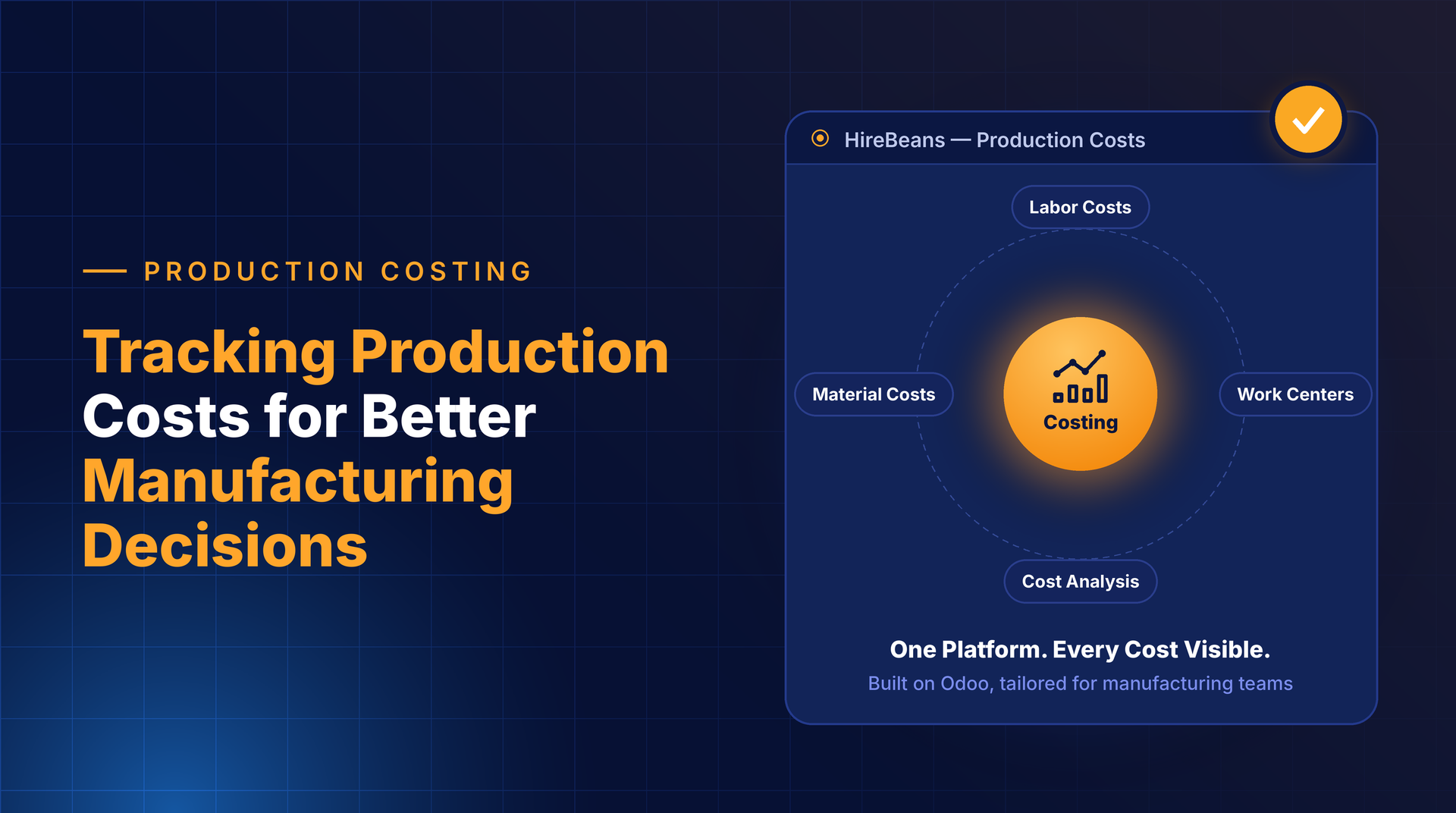
This article explains how Odoo Manufacturing helps you build a cost picture from materials, work centre time, and other costs, and how to use it in everyday decisions.
The Challenge
Production cost estimates are often based on material cost alone, perhaps with a standard percentage added for everything else. This hides important differences. A product that needs a long machine setup and several operations is more expensive than a simple one that uses the same amount of material, but a flat markup treats them as equal.
Cost estimates also go stale. Material prices change, scrap occurs, and jobs take longer than planned. If the cost recorded in the system is never compared with what happened on the shop floor, the business keeps pricing according to assumptions that are no longer true.
Key Features
A Real-World Example
- ✓Imagine a small manufacturer of stainless steel kitchen equipment. They make two products using the same sheet metal: a simple shelf and a custom prep table that requires welding, polishing, and assembly. Previously, they priced both with a standard markup on material cost.
- ✓The company sets up work centres for cutting, welding, polishing, and assembly, each with an hourly cost that includes labour and machine running costs as the finance team defines them. Operations are added to the BoMs with expected durations. Operators start and stop work orders on a tablet to record actual time.
- ✓After a month, the manager reviews the cost analysis of completed manufacturing orders. The shelf cost is close to the estimate, but the prep table takes noticeably longer in welding than planned, which raises its real cost. The company can now decide whether to adjust the price, improve the welding process, or revise the planned time.
- ✓Cost tracking is only useful when the inputs are credible. Decide how hourly rates are calculated, make sure operators record time consistently, and involve your accountant so the costs in the system match your accounting approach.
Conclusion
Knowing what each product costs to make turns pricing and planning from guesswork into informed decisions. By capturing materials, time, and other costs, and comparing planned against actual, you can see where margins are healthy and where they are being lost.
Start with your most important products, keep the cost structure simple, and refine it as your team gets used to recording data. A reasonable cost today is more useful than a perfect one that never gets built.
Know what every product really costs to make, and price, plan, and improve with confidence. Book a Free Demo at hirebeans.cloud
Book a Free Demo