
Introduction
“AI agents in your ERP” is one of those phrases that's been said so often, in so many pitch decks, that it's started to mean almost nothing. So it's worth asking a plainer question: what does an AI agent sitting on top of Odoo actually do, mechanically, that a human with five open browser tabs doesn't already do slower?
The Actual Problem It's Solving
In a standard Odoo setup, a simple business question — “which customer orders are at risk of late delivery, and why?” — isn't actually simple to answer. It requires checking Sales for the order, Inventory for stock levels, Manufacturing for production schedules, and Purchase for incoming components, then manually connecting those four data points into one answer. Multiply that by every recurring question a manager asks in a week, and the real cost isn't the ERP being incomplete — it's the time spent manually joining data that's already sitting in the same database, just behind different screens.
An AI agent in this context isn't a chatbot bolted onto the login screen. It's something that reads across those connected modules on request, in plain language, and returns an answer with the reasoning attached — which orders, why they're at risk, and what the contributing factor was (a missing component, a scheduling conflict, a quality hold).
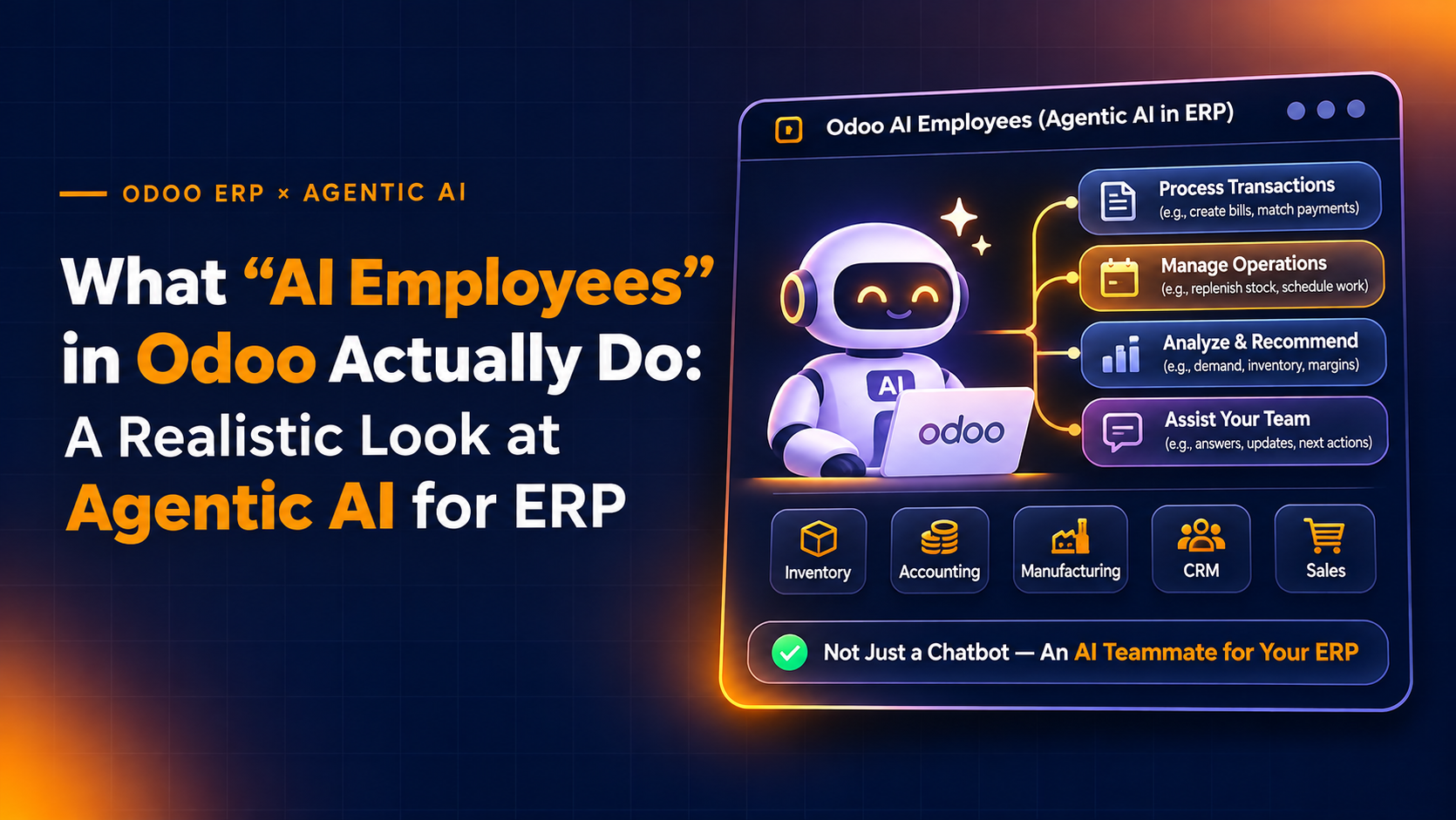
What This Looks Like in Practice (renders as a feature grid)
Where the Human Still Has to Be in the Loop
This is the part most AI-in-ERP marketing skips, and it matters: an agent surfacing “three orders at risk this week, here's why” is useful precisely because it still hands the decision back to a person — whether to expedite a purchase order, whether to notify the customer, what to actually say. The value isn't replacing judgment. It's removing the five-screens-and-a-spreadsheet step that used to happen before judgment could even start.
Equally, feature availability genuinely varies by Odoo version and edition, and the quality of an AI agent's answers is only as good as the data discipline behind it — an agent reading from a database with messy inventory records or stale sales data will confidently produce a wrong answer. AI on top of a messy implementation doesn't fix the mess; it just answers questions faster about data that was already unreliable.
The Honest Takeaway
Agentic AI in Odoo is best understood as collapsing a multi-screen, multi-export manual process into a single question and a single answer — not as a replacement for the people making decisions on that answer. That's a less exciting sentence than most AI marketing, but it's the accurate one, and it's also the version that actually holds up once a business starts using it day to day.
Ready to Try It?
Curious what an AI agent could answer inside your own Odoo data? Book a Free Demo at hirebeans.cloud.
Book a Free Demo