
Introduction
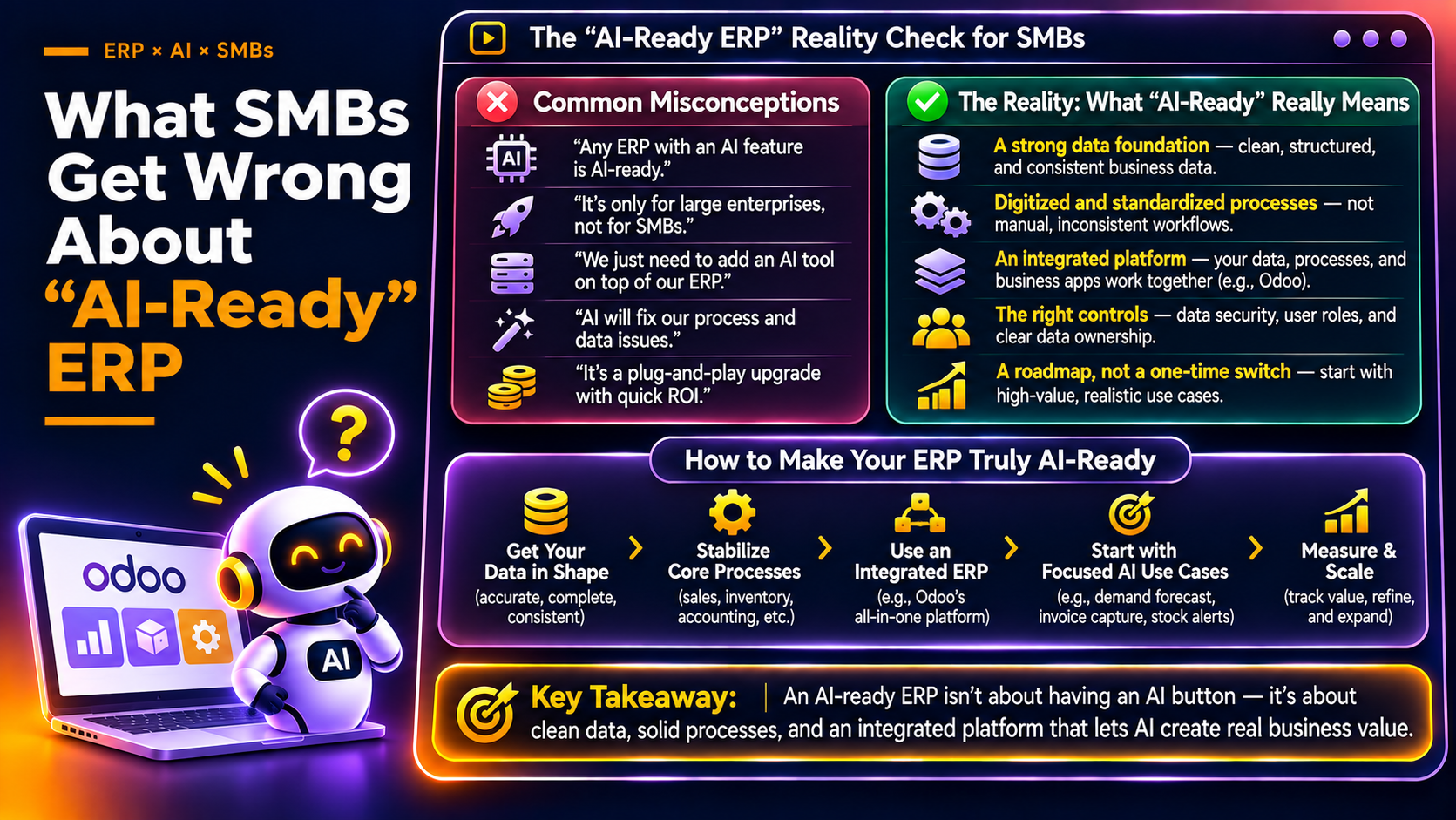
“AI-ready” has become one of those labels every ERP vendor applies to itself, which makes it almost useless as a buying signal on its own. The businesses that get the most value out of AI agents aren't the ones that bought the product with the best AI marketing — they're the ones that understood, correctly, what readiness actually requires before evaluating any vendor's claim.
Mistake 1: Assuming “AI-Ready” Is a Feature You Buy, Not a State You Build
The most common misunderstanding is treating AI readiness as something a software purchase confers automatically. In reality, as covered elsewhere on this blog, AI agents are only as good as the system of record underneath them. A business can buy the most AI-capable ERP on the market and still get poor results if its data is fragmented, its configuration doesn't match real workflows, or its historical records were migrated sloppily. Readiness is mostly about the business's own data and process discipline, not the vendor's feature list.
Mistake 2: Expecting AI to Fix a Messy Implementation
A closely related error: treating an AI layer as a way to work around a struggling implementation rather than fixing it first. An AI agent reading from inconsistent inventory records or duplicate customer entries doesn't correct those problems — it reasons from them and produces a confident-sounding wrong answer, which is often more dangerous than an obviously broken report, because it doesn't look broken.
Mistake 3: Underestimating How Much Governance Still Matters
AI agents reduce manual work, but they don't remove the need for data entry discipline, consistent process, and defined ownership. A business where different people enter data differently, or where there's no single owner accountable for data quality, will see that inconsistency degrade an AI agent's output the same way it degrades a human analyst's. Agentic AI doesn't replace governance — it makes the cost of skipping it more visible, faster.
Mistake 4: Evaluating AI Features in a Demo, Not Against Real Data
A vendor demo of an AI feature is, almost by definition, running against clean, curated sample data. That's not a meaningful test of what the feature will do against your actual business's real, messier data. The more useful evaluation question isn't “does this look impressive in the demo” — it's “how does this perform once it's reading from my inconsistent legacy data, my partially migrated history, and my team's actual data-entry habits.”
Mistake 5: Treating This as an All-or-Nothing Decision
Some businesses delay adopting any AI capability until their data is “perfect,” which in practice means indefinitely. The more realistic approach is starting with narrow, lower-stakes AI use cases — lead scoring, reporting assistance — where the cost of an imperfect early result is low, and building both the organizational trust and the data discipline that higher-stakes use cases, like automated reconciliation, eventually need.
What Genuine Readiness Actually Looks Like
- ✓A single connected database across departments, not fragmented spreadsheets or disconnected point solutions.
- ✓Configuration that matches how the business actually operates, not a generic template.
- ✓Clean, complete historical data from a properly executed migration.
- ✓A clear owner accountable for ongoing data quality and consistent entry.
- ✓Realistic expectations set from evaluating features against your own messy data, not a vendor's curated demo.
Ready to Try It?
Want an honest read on whether your Odoo setup is actually AI-ready? Book a Free Demo at hirebeans.cloud.
Book a Free Demo