
Quick Answer
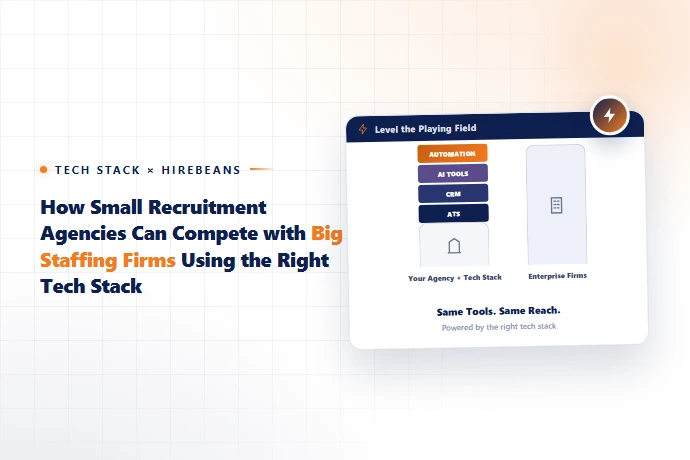
Small recruitment agencies compete with large staffing firms not by matching their headcount, but by matching their speed, responsiveness, and data-driven delivery — all of which the right software makes possible without an enterprise budget. A small agency with fast, well-integrated software can respond to job orders faster, present cleaner candidate shortlists, and prove delivery with real metrics, closing the gap that used to require dozens of recruiters and expensive enterprise systems.
Why "Bigger" Used to Automatically Mean "Better" — and Why That's Changing
For years, large staffing firms held a structural advantage: more recruiters meant more candidate coverage, more client relationships, and more capacity to run multiple searches simultaneously. Small agencies competed mostly on relationships and niche specialization, often while operating on spreadsheets and inboxes behind the scenes. That gap has narrowed significantly. Modern recruitment software gives a 3-person agency access to AI-assisted sourcing, automated screening, and multi-client dashboards that used to require an enterprise IT budget — the constraint has shifted from "can we afford the technology" to "are we using it well."
Where Small Agencies Can Actually Win
- ✓1. Speed of Response
- ✓Large firms often have layered approval processes and account management structures that slow down how quickly a candidate gets submitted. A small agency with a fast, well-configured ATS can go from job order to first submission in hours, not days — a genuine competitive advantage clients notice immediately.
- ✓2. Proof of Delivery Through Data
- ✓Clients increasingly expect recruiters to speak in metrics, not anecdotes. A small agency that can show time-to-fill, submission-to-interview ratio, and SLA adherence on demand looks just as credible as a large firm's account manager — sometimes more so, because the data is specific to that client's roles rather than firm-wide averages. See our guide on the recruitment agency KPIs worth tracking to build this into your client conversations.
- ✓3. Candidate Experience
- ✓Candidate portals, self-serve interview scheduling, and fast, personal communication are easier to execute well at a small agency, where a recruiter genuinely knows each candidate, than at a large firm running high-volume, semi-automated outreach. Software that supports this — rather than a stripped-down internal tool built for volume — lets a small agency lean into that advantage instead of looking outdated by comparison.
- ✓4. Cost Structure That Scales With You, Not Against You
- ✓This is where software choice matters most directly. Enterprise platforms are often priced and built for large teams, with per-seat costs that make them prohibitively expensive for a 3–10 recruiter agency. Choosing a platform with flat-rate pricing instead of per-recruiter fees means a small agency isn't taxed for growing, and isn't paying enterprise-scale software costs on a boutique-agency budget.
Small-Agency-Friendly Tech Stack vs. Enterprise Tech Stack
Factor | Typical Enterprise Stack | Small-Agency-Friendly Stack |
|---|---|---|
Pricing | Per-seat, often with minimum seat counts | Flat-rate or usage-based, scales with actual growth |
Implementation | Weeks, often requires a dedicated systems admin | Fast, self-serve setup — see what to expect in week one |
AI-assisted sourcing/screening | Available, but often as a costly add-on module | Increasingly built in as standard |
Client/candidate portals | Available but complex to configure | Built in and ready to use quickly |
A Practical Starting Checklist for Small Agencies
- ✓1. Confirm pricing scales with your actual growth plan, not just your current headcount — revisit our buyer's guide for the full pricing question set.
- ✓2. Prioritize fast implementation over feature breadth you won't use in year one.
- ✓3. Use AI-assisted screening to punch above your recruiter headcount on applicant volume.
- ✓4. Invest in candidate and client portals early — they're one of the clearest visible signals of professionalism to a prospective client comparing you against a larger competitor.
Build a Lean, Competitive Tech Stack
HireBeans offers flat-rate pricing, AI-assisted screening, and built-in client/candidate portals designed for agencies that need enterprise-grade capability without enterprise-grade cost. Start a free 30-day trial, no credit card required.